
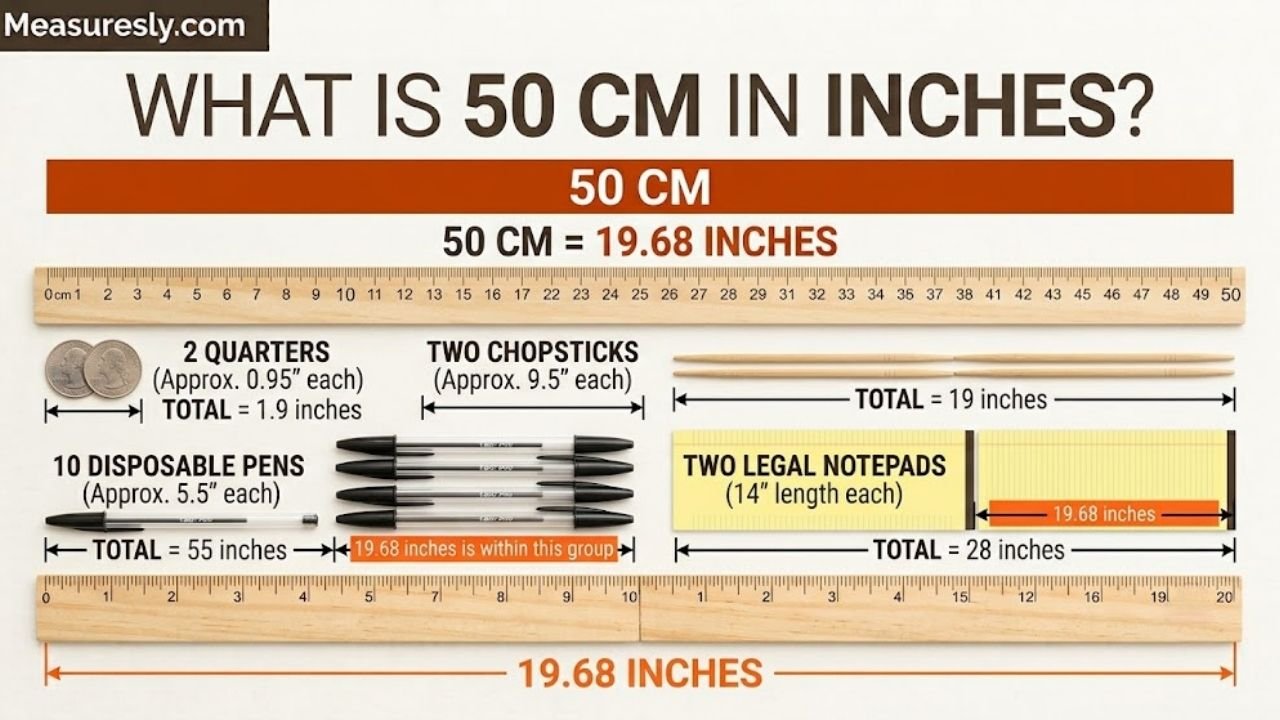

Last month I watched a friend order a monitor stand online because the listing said it stood “50 cm tall,” and she assumed that meant roughly 20 inches of desk space. It actually measures 19.7 inches, and that small gap made the stand sit just a bit lower than she expected against her wall shelf. This tiny mix-up happens constantly because people round centimeters to inches without checking the real math first.
So here is the direct answer: 50 cm in inches equals 19.685 inches, and most people simplify that to 19.7 inches for everyday use. This number stays fixed everywhere because it comes from a global measurement standard, not a rough guess. Once you understand this baseline, you can apply the same logic to almost any centimeter figure you come across, whether you are shopping, traveling, or working on a home project.
50 cm in Inches Conversion Chart: Quick and Accurate Measurement
Understanding how much 50 cm equals in different measurement units helps make everyday measurements easier, whether you are working on DIY projects, checking product sizes, or comparing dimensions. The following conversion chart provides quick and accurate values for converting 50 cm into inches, feet, millimeters, and meters.
| Unit | Value |
| Centimeters | 50 |
| Inches | 19.685 in |
| Millimeters | 500 mm |
| Feet | 1.64 ft |
| Meters | 0.5 m |
| Yards | 0.547 yd |
| Micrometers | 500,000 µm |
50 cm to Inches, MM, Feet, and Other Units
People often search for multiple conversions instead of just inches. Combining all common conversions into one section improves SEO and user experience.
50 cm to Inches
Since one inch equals exactly 2.54 centimeters, dividing 50 by 2.54 gives:
- 50 ÷ 2.54 = 19.685 in
This conversion is widely used in shopping, tailoring, furniture design, and construction.
50 cm to Millimeters
Millimeters provide greater precision than centimeters. Since one centimeter equals 10 millimeters, 50 cm equals:
- 50 × 10 = 500 mm
This conversion is commonly used in manufacturing, mechanical engineering, 3D printing, and construction.
50 cm to Feet
There are 30.48 centimeters in one foot.
Therefore:
- 50 ÷ 30.48 = 1.64 feet
Although this conversion is less common in everyday life, it is useful in home improvement and architectural measurements.
50 cm to Meters
Since one meter equals 100 centimeters, the conversion is:
- 50 ÷ 100 = 0.5 meters
This measurement is often used in scientific calculations and technical documentation.
50 cm Comparison Chart
| Measurement Type | Equivalent Size |
| Centimeters | 50 cm |
| Inches | 19.685 in |
| Millimeters | 500 mm |
| Carry-on suitcase | Shorter side length |
| Backpack | Standing packed height |
| Guitar case | Width at broadest point |
| Kitchen counter | Standard depth |
| Yoga mat | Standard width |
| Side table | Average height |
| Interior door | Approximate width without frame |
| Skateboard deck | Standard length |
| Violin body | Length without neck |
How Many Inches Is 50 cm?
50 cm to inches is 19.685 in, which is significant in various applications such as furniture design, clothing measurements, and interior layout planning. Because inches carry more familiarity in countries like the United States, professionals tend to convert and use this unit whenever a listing or blueprint originally comes in metric form.
This conversion follows the same 2.54 cm-per-inch world standard, meaning the answer stays the same regardless of where you calculate it. When you need to order furniture or check a suitcase against airline size limits, this exact number keeps the process free of guesswork.
How Long Is 50 cm in Simple Terms?
Fifty centimeters is roughly the width of a standard interior door frame or the height of a small side table next to a sofa. It is long enough to need both hands to measure comfortably and short enough to still fit inside most backpacks or carry-on bags.
Length and height are terms that often get mixed up, though they carry the same meaning in this context, since 50 cm defines a straight linear measurement either way. When you connect this number to something you can picture or touch, comparing it against other sizes becomes far quicker and much easier.
Everyday Objects That Help Visualize 50 cm
Many people struggle to estimate length without a measuring tape nearby. Fortunately, several common items sit close to 50 cm in size, so direct visual estimation becomes far simpler once you know what to look for.
Examples include:
- A carry-on suitcase’s shorter side
- A large travel backpack, standing packed
- A full-size guitar case at its widest point
- A kitchen countertop’s standard depth
- A small side table’s average height
Such comparisons let you estimate size while shopping, planning a room layout, or checking whether furniture will fit through a doorway before you even pull out a tape measure.
What Is 50 cm in Inches Compared to Nearby Measurements?
Seeing this measurement next to similar values helps you understand where it fits within a broader range. This table below keeps the layout simple so you can scan it quickly and pull out whatever number you need.
| Centimeters (cm) | Inches (Exact) | Inches (Rounded) |
| 30 cm | 11.81 in | 11.8 in |
| 40 cm | 15.75 in | 15.7 in |
| 45 cm | 17.72 in | 17.7 in |
| 50 cm | 19.69 in | 19.7 in |
| 55 cm | 21.65 in | 21.7 in |
| 60 cm | 23.62 in | 23.6 in |
| 70 cm | 27.56 in | 27.6 in |
Once you look across this range, you start noticing a pattern. Every ten centimeters adds roughly four inches, which makes it easier to estimate other nearby measurements without recalculating each one from scratch.
4 Everyday Objects Close to 50 cm in Length
Numbers alone rarely stay in memory for long, but comparing them to familiar objects makes the size click instantly. Below are twelve common items and references that measure close to 50 cm, giving you a mental picture instead of just a decimal figure.
Carry-on suitcase shorter side
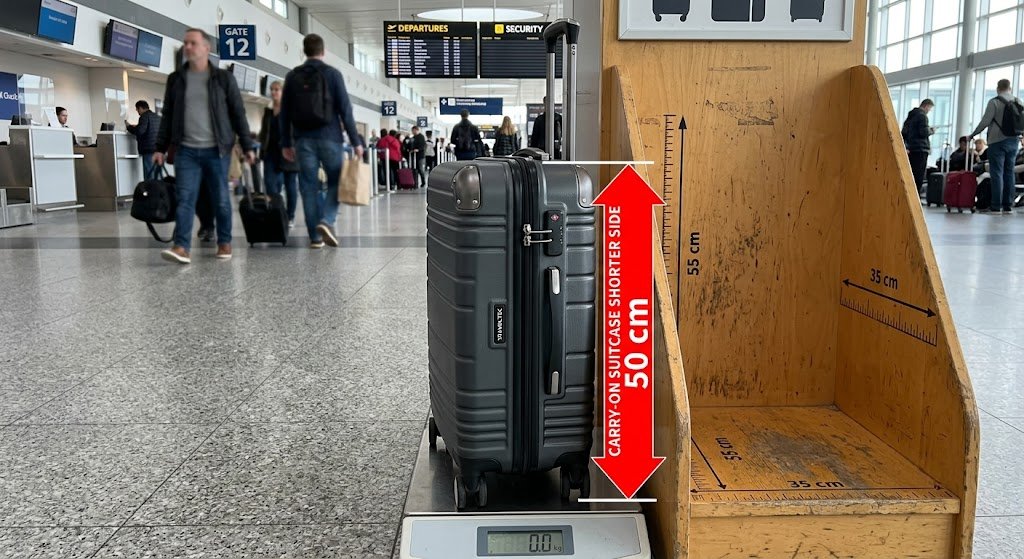
Most airline carry-on bags have a shorter side that lands close to 19.7 inches, since airlines design these limits around standard overhead bin space. Next time you check baggage rules before a flight, you already know roughly how big that number looks in real life.
Large travel backpack height
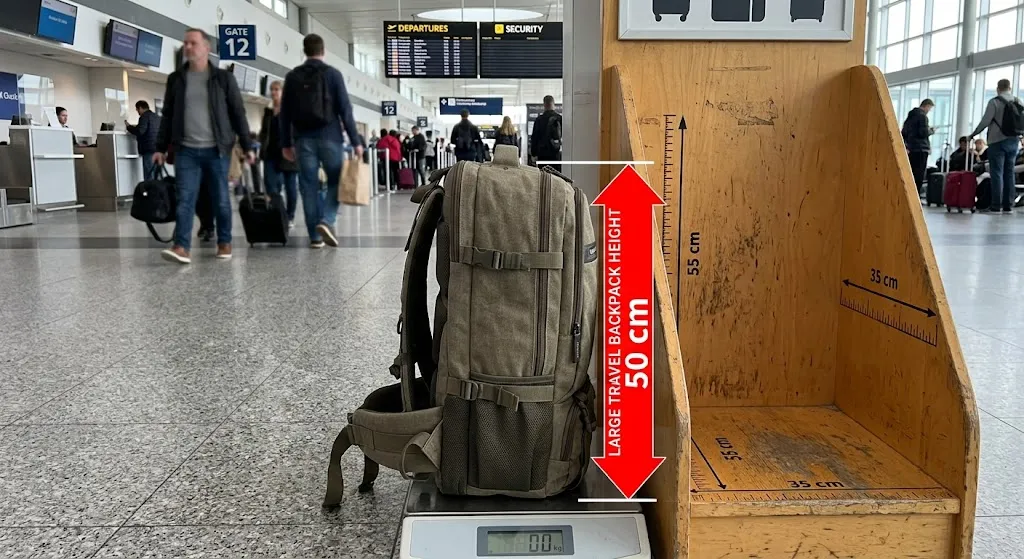
Big hiking or travel backpacks often stand close to this height once fully packed and upright. This size gives enough room for a multi-day trip while still staying manageable to carry through an airport or train station.
Standard interior door width
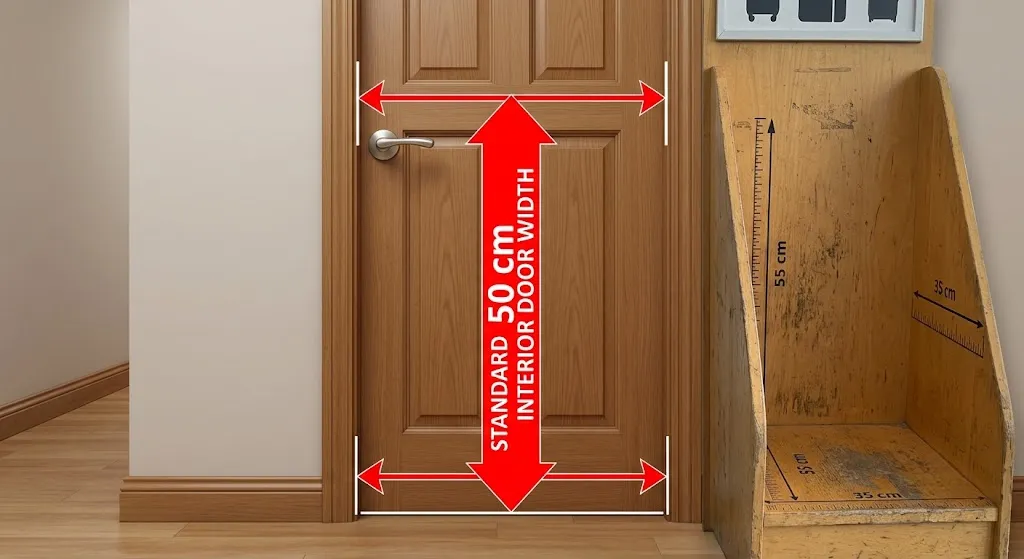
An average interior door, measured without its frame, sits close to this width in many homes. This comparison helps when you measure furniture that needs to pass through a doorway during a move or renovation.
Full-size violin body
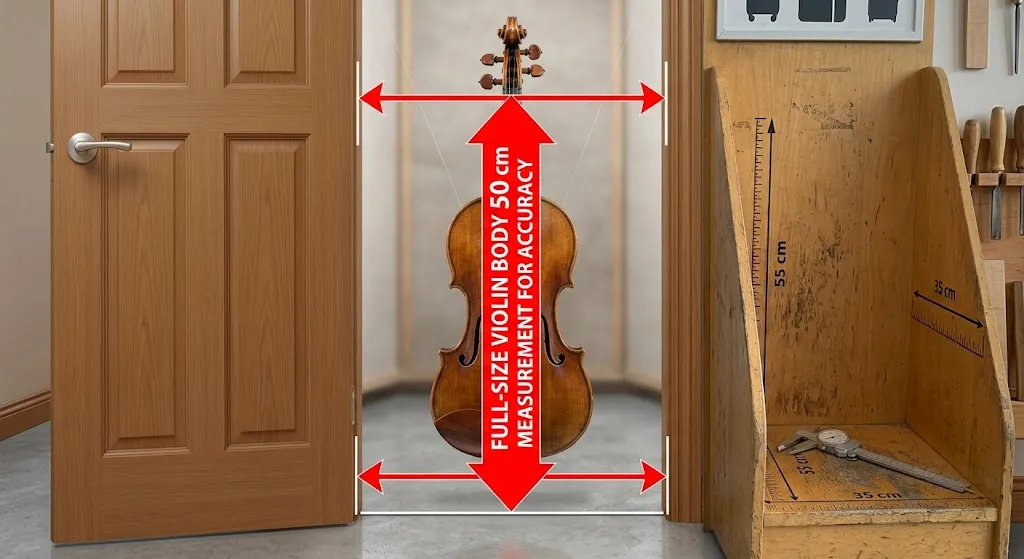
A violin’s body alone, excluding the neck and scroll, runs close to this length range. Musicians often deal with metric specifications since many instruments come from manufacturers overseas.
Precision V/s Convenience in Measurement Conversion
The gap between 19.685 inches and a rounded 20 inches looks tiny on paper, but it matters more than people expect in certain situations. A carpenter cutting shelving, a tailor adjusting fabric, or an engineer designing a component cannot absorb that 0.3 inch difference, since it changes whether the final piece actually fits.
Casual estimates work perfectly fine for everyday shopping or general visualization, so you do not need to stress over decimals every single time. However, technical projects always call for the exact figure rather than a rounded shortcut, and understanding what is 50 cm in inches at both levels gives you the flexibility to switch depending on your situation.
Additional Unit Conversions Worth Knowing
Beyond inches, 50 cm also converts cleanly into a few other units you might need depending on your project. It equals exactly 0.5 meters, since a meter contains 100 centimeters by definition. It also comes out to roughly 1.64 feet and about 0.547 yards.
| Unit | Value |
| Meters | 0.5 m |
| Feet | 1.64 ft |
| Yards | 0.547 yd |
| Millimeters | 500 mm |
| Inches | 19.685 in |
Knowing these related figures rounds out your understanding and saves you from switching between separate conversion tools every time a new unit comes up.
Final thought on 50 cm to Inches Conversion
Knowing that 50 cm equals 19.685 inches gives you a reliable anchor point for handling almost any measurement conversion you run into next. Whether you round it to 19.7 for a quick mental picture or keep the exact figure for precise work, you now have both the formula and the real-world context to use it confidently. Next time a product listing, travel restriction, or furniture spec sheet shows you a centimeter figure, you will already know exactly what it means in inches without opening another tab to check.
Frequently Asked Questions
50 cm equals 19.685 inches, commonly rounded to 19.7 inches.
No, 50 cm is about 0.3 inches less than 20 inches.
Divide the centimeter value by 2.54 to get inches.
50 cm equals approximately 1.64 feet.
This standard was set internationally in 1959 and remains fixed today.
50 cm equals exactly 500 millimeters.
Yes, divide by 2.5 for a quick, close estimate.
It rounds closer to 19.7 inches, nearer to 20 but not equal to it.
50 cm equals roughly 0.547 yards.
Yes, many tables, shelves, and counters use this depth or height.
Read More: How Long Is 20 Inches? | How Big Is 2 Inches?
Aarav Choudhary
I’m Aarav Choudhary, a content researcher and technical writer with a strong interest in online calculators, unit conversion tools, and educational resources. At Measuresly, I focus on simplifying complex calculations into practical, reader-friendly content. Every article I write is thoroughly researched, fact-checked, and regularly updated to ensure accuracy and reliability.