
Have you ever looked at a measurement and wondered what it would look like in real life? Eleven feet may seem like an ordinary number, but imagining that distance can be difficult until you compare it with familiar spaces and objects. Whether you are arranging furniture, planning a DIY project, purchasing building materials, or learning about unit conversions, understanding this measurement can help you make better decisions.
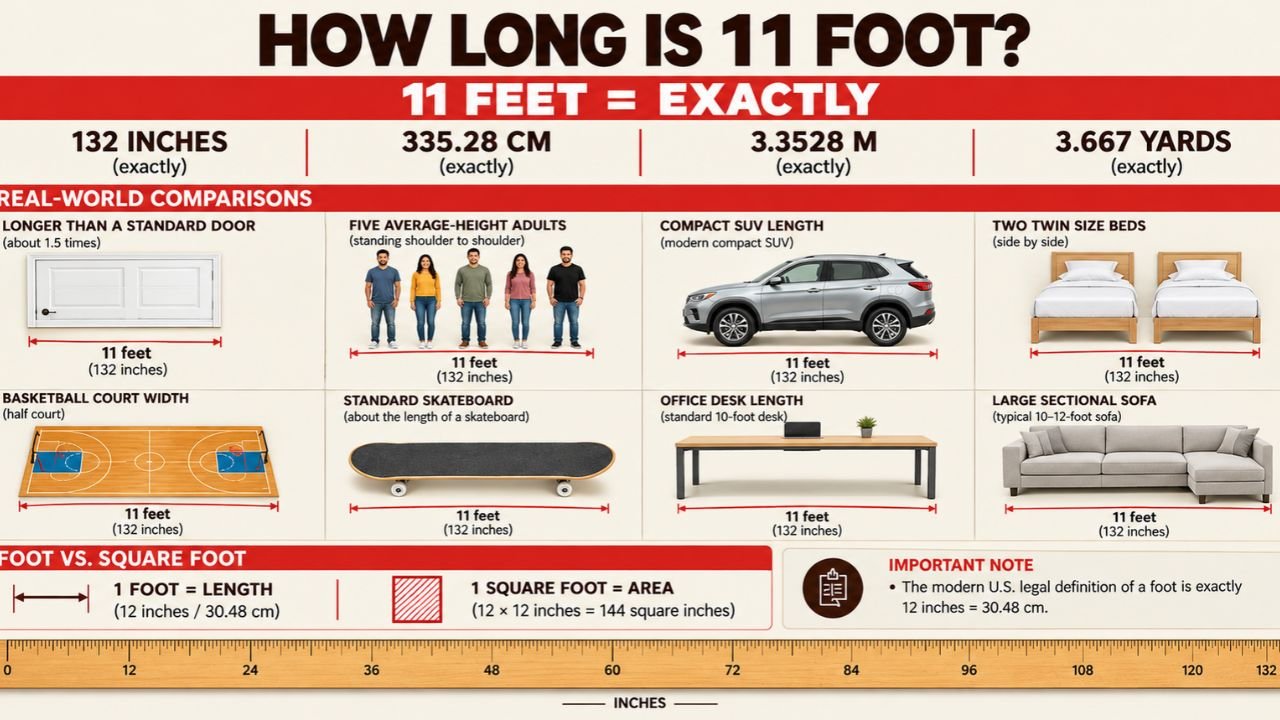
So, how long is 11 foot? Eleven feet equals 132 inches, 3.3528 meters, and 335.28 centimeters. That makes it slightly more than three meters long and a useful reference point for measuring walls, equipment, and other large objects.
In this guide, we will explore the size of 11 feet, explain the difference between feet and square feet, show you how to calculate linear measurements, and answer common questions about measuring long objects. You will also learn how to avoid mistakes when converting units or estimating dimensions.
How Long Is 11 Foot in Different Units?
The easiest way to understand 11 feet is to convert it into measurement units you may already use. Feet and inches are common in the United States, while centimeters and meters are widely used in metric measurements.
Because one international foot equals exactly 0.3048 meters, these conversions can be calculated precisely
Here is a quick conversion chart:
| Unit | Equivalent of 11 feet |
| Feet | 11 feet |
| Inches | 132 inches |
| Centimeters | 335.28 cm |
| Meters | 3.3528 m |
| Millimeters | 3,352.8 mm |
| Yards | Approximately 3.67 yards |
These values provide a convenient reference when you need to compare product dimensions, plan a home project, or communicate measurements with someone who uses a different unit system.
How to Convert 11 Feet Into Inches
A foot contains 12 inches. Therefore, converting feet into inches only requires multiplication.
Formula:
Inches = Feet × 12
For 11 feet:
11 × 12 = 132 inches.
This means an object measuring 11 feet from end to end has a length of 132 inches.
How to Convert 11 Feet Into Meters
To convert feet into meters, multiply the measurement by 0.3048.
11 × 0.3048 = 3.3528 meters.
If you only need a rough estimate, you can describe 11 feet as approximately 3.35 meters. For projects involving cutting, installation, or precise fitting, use the more accurate value.
How to Convert 11 Feet Into Centimeters
Since one foot equals 30.48 centimeters, the calculation is:
11 × 30.48 = 335.28 centimeters.
This conversion is particularly helpful when measuring with a metric tape or comparing the dimensions of imported products.
What Does 11 Feet Look Like in Everyday Life?
Measurements become easier to understand when they are connected to things you can see or experience. Although objects vary in size, several everyday situations can help you visualize an 11-foot distance.
1. A Long Section of a Living Room
Imagine a living room with enough space for a sofa, a small table, and additional furniture along one wall. Depending on the dimensions of those items, the complete arrangement might occupy a length close to 11 feet.
If you are redesigning a room, measuring the wall first can help you determine whether the furniture will fit comfortably.
Remember that an 11-foot wall does not mean the room has an area of 11 square feet. Wall length and floor area are different measurements.
2. A Large Furniture Arrangement
Some furniture combinations can extend across a distance of approximately 11 feet. For example, a sofa placed beside a cabinet or side table may create a long arrangement along a wall.
Before buying furniture, measure each item individually and include enough space for doors, drawers, and walking paths. Product photographs can be useful for inspiration, but they are not reliable substitutes for actual dimensions.
3. An Outdoor Installation
Eleven feet can also be a helpful reference when planning a section of fencing, garden edging, a utility installation, or an outdoor storage arrangement.
Suppose you want to install a structure along an 11-foot boundary. Marking the start and end points before purchasing materials can help you estimate the amount required.
The actual quantity may differ if the project includes posts, joints, overlaps, or cutting waste.
4. A Long Household Object
Certain poles, compact equipment, and recreational products may have dimensions close to 11 feet. However, there is no single standard size for all such products.
If you are transporting an object, check its full dimensions rather than relying on a general comparison. Include any attachments or projecting parts that might affect whether it fits inside a vehicle or storage space.
How Long Is 11 Linear Foot?
The phrase “how long is 11 linear foot” is another way people may ask about an 11-foot length, particularly when shopping for construction or home improvement materials.
Eleven linear feet equals 11 feet, or 132 inches.
The word linear emphasizes that the measurement follows one dimension. It describes how long something is rather than how much surface area it covers.
Understanding Linear Feet
Imagine buying a strip of decorative molding for a wall. If the strip is 11 feet long, its linear length is 11 feet, regardless of whether it is narrow or wide.
Linear feet are commonly used for products such as:
- Baseboards and wall trim.
- Certain types of fencing.
- Cable and piping.
- Lumber and long wooden components.
- Shelving and countertop edges.
The way a product is priced depends on the supplier. Some products are sold per linear foot, while others are sold in fixed lengths or by another unit.
How to Calculate Linear Feet
For a single straight piece, measure its length and express the result in feet.
For multiple sections, add their lengths together.
Consider a simple trim installation with three sections:
- Section one: 3 feet.
- Section two: 4 feet.
- Section three: 4 feet.
Total length = 3 + 4 + 4 = 11 linear feet.
You would need 11 linear feet to cover those measured sections before accounting for corners, cuts, or extra material.
If you are purchasing long pieces that must be cut, calculate how the sections will fit into the available stock lengths. This can prevent unnecessary waste.
How Long Is 11 Square Foot?
The keyword “how long is 11 square foot” raises an important measurement question: square feet do not describe length. They describe area.
Eleven square feet represents a surface area of 11 square feet. Its length depends on the width and shape of the surface.
For example, a rectangular surface measuring 2 feet by 5.5 feet has an area of 11 square feet.
Area = Length × Width
2 × 5.5 = 11 square feet.
A different rectangle measuring 1 foot by 11 feet also has an area of 11 square feet, even though its proportions are different.
What Does an 11-Square-Foot Area Look Like?
Picture a small rectangular section of flooring, a narrow storage surface, or an area that needs to be covered with a suitable material.
If the surface is 2 feet wide and 5.5 feet long, its area is 11 square feet. If you change the width, the length must change to maintain the same total area.
For a perfect square with an area of 11 square feet, each side would measure approximately 3.32 feet.
This illustrates why knowing the area alone does not tell you the exact length of a surface.
Linear Feet vs. Square Feet
| Measurement | What it describes | Example |
| Linear feet | Length in one dimension | 11 feet of trim |
| Square feet | Surface area in two dimensions | 11 square feet of flooring |
| Cubic feet | Volume in three dimensions | 11 cubic feet of storage space |
Understanding these differences is especially important when comparing prices. Eleven linear feet of a material cannot automatically be treated as 11 square feet of coverage.
The width of the material determines how much area each linear foot covers.
How to Measure an 11-Foot Distance Correctly
You can measure 11 feet using a standard tape measure or another suitable measuring tool. The important thing is to identify the correct endpoints and keep the measurement aligned with the intended path.
Step 1: Decide What You Need to Measure
Determine whether you need the length of an object, the distance between two points, or the length of a section along a wall.
These measurements may produce different results depending on the shape of the object and where you place the measuring tool.
Step 2: Select a Suitable Tool
A tape measure works well for most short indoor measurements. A measuring wheel or laser distance meter may be more convenient for longer distances.
For precision work, follow the tool’s instructions and verify its suitability for the required accuracy.
Step 3: Measure From the Zero Point
Position the beginning of the measuring tool at the starting point. Extend it carefully until you reach the 11-foot mark.
If your tool displays inches, look for 132 inches. If it displays metric units, look for 3.3528 meters or 335.28 centimeters.
Step 4: Mark the Endpoint
For projects involving furniture placement or installation, mark the endpoint with a pencil or removable marker.
This provides a visible reference when comparing the available space with the dimensions of another object.
Step 5: Check the Result Again
Repeat the measurement before cutting materials or making an expensive purchase.
Pay attention to whether the project requires internal dimensions, external dimensions, gaps, overlaps, or additional space for fittings.
How Much Is 11 Foot Long at Subway?
The search phrase “how much is 11 foot long at Subway” may refer to a sandwich’s length or its price.
These questions need to be separated because 11 feet is a measurement, whereas a Subway Footlong is a named menu item.
An 11-foot length equals 132 inches. That is much longer than an ordinary individual footlong sandwich.
What Is the Length of a Subway Footlong?
The name “Footlong” refers to Subway’s sandwich product. The actual dimensions of a prepared sandwich may vary, so the product name should not be treated as a guarantee of an exact measured length.
If you need the physical length for a comparison, measure the sandwich from end to end.
How Much Does a Subway Footlong Cost?
There is no single price that applies to every Subway location. The cost may depend on the sandwich, location, promotions, and ordering method.
For the most accurate price, check the current menu for your local restaurant.
This clarification helps readers distinguish between a question about measurement and a question about food pricing without confusing the two.
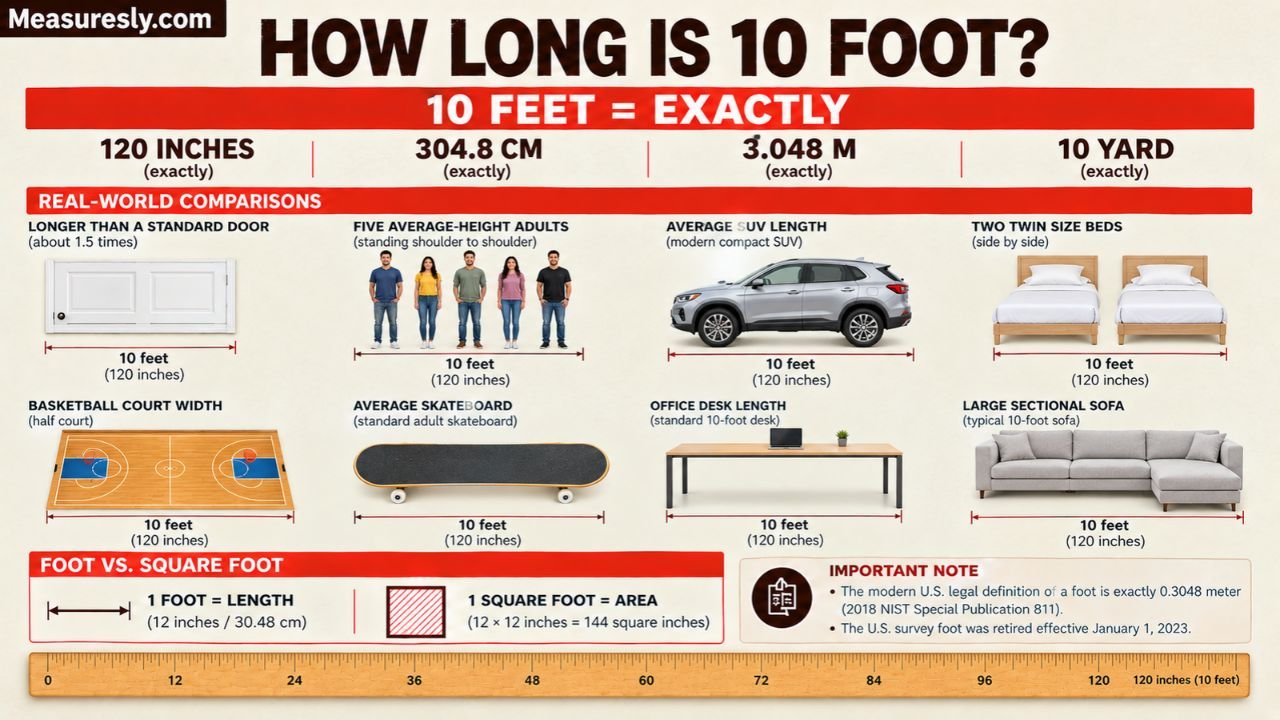
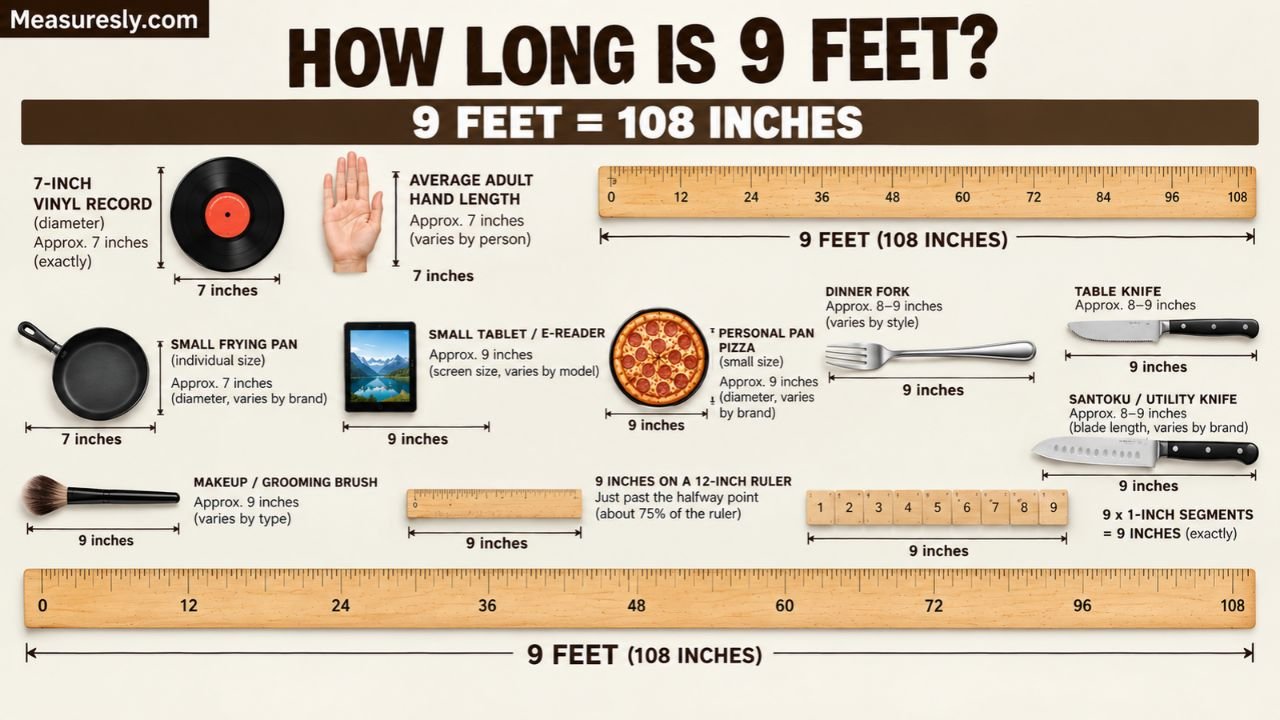
Read More: How Long Is 9 Foot? Complete Guide to 9 Feet in Inches, CM, Linear Feet & More
Practical Examples of Using an 11-Foot Measurement
Understanding the conversion is useful, but applying it to an actual task is what makes the information valuable.
Example 1: Measuring a Wall for Furniture
Suppose a wall is 11 feet long and you want to position a sofa and a cabinet along it.
Convert the available length into 132 inches. Measure each piece of furniture and add the space required between them.
If the combined dimensions exceed 132 inches, the arrangement will not fit along the wall as planned.
Example 2: Estimating Trim for a DIY Project
Imagine that your measured installation requires 11 linear feet of trim.
Before buying the material, check the stock lengths offered by the supplier and plan the necessary cuts. If the trim must be cut at corners or around obstacles, you may need additional material.
The best quantity depends on the installation layout and whether offcuts can be reused.
Example 3: Calculating the Area of a Surface
Suppose you are covering a rectangular area that measures 2 feet by 5.5 feet.
Multiply the dimensions:
2 × 5.5 = 11 square feet.
If the covering material is sold by area, this calculation gives you the starting quantity. You should then account for packaging sizes and the material required for cuts or installation.
Example 4: Sharing Dimensions With a Supplier
A supplier who works with metric measurements may ask you to provide the dimensions in centimeters or meters.
Instead of saying only “11 feet,” you can provide the equivalent of 3.3528 meters or 335.28 centimeters.
Including the unit clearly reduces the possibility of confusion during ordering and installation.
These scenarios are examples of practical measurement workflows. Actual product dimensions and material requirements should always be verified for the specific project.
Common Mistakes to Avoid When Working With 11 Feet
Even straightforward conversions can cause problems when the units are unclear.
Confusing feet with inches: Eleven feet equals 132 inches, not 11 inches. Always check the unit before calculating or ordering materials.
Mixing length with area: Feet measure length, while square feet measure area. To calculate a rectangular surface, you need both its length and width.
Relying on visual estimates: Furniture and equipment vary in size. Measure the actual item when fit or transport dimensions matter.
Ignoring cutting requirements: An installation that requires 11 linear feet may need more material if cuts, corners, or unusable offcuts are involved.
Rounding too early: A rough estimate of 3.35 meters may be sufficient for visualization, but precise projects should use the appropriate level of accuracy.
Avoiding these mistakes helps you use measurements more confidently and reduces the risk of ordering the wrong amount of material.
Frequently Asked Questions
Eleven feet equals 132 inches. Multiply 11 by 12 to convert feet into inches.
Yes. Eleven feet equals 3.3528 meters, which is 0.3528 meters longer than 3 meters.
Eleven feet equals 335.28 centimeters.
Eleven linear feet is the same length as 11 feet, or 132 inches. The term is commonly used when measuring trim, piping, cable, and other long materials.
Eleven square feet is approximately 1.0219 square meters. Its dimensions depend on the shape and width of the surface.
Yes, a rectangle measuring 11 feet long and 1 foot wide has an area of 11 square feet. However, other shapes can have the same area with different dimensions.
Use a ruler, meterstick, or another measuring tool with known dimensions to mark the distance. Avoid treating footsteps or hand spans as exact units because they vary between people.
No. A Subway Footlong is a named sandwich product, while 11 feet is a separate unit of length equal to 132 inch.
Conclusion
Understanding how long 11 foot is becomes much easier when you combine unit conversions with practical examples. Eleven feet equals 132 inches, 3.3528 meters, and 335.28 centimeters, making it a useful reference for household layouts, equipment dimensions, and home improvement projects.
The most important lesson is to distinguish between length and area. Eleven linear feet describes a distance, while 11 square feet describes a surface area that depends on two dimensions.
Whether you are measuring a wall, purchasing trim, estimating flooring, or comparing everyday objects, always confirm the units before making a decision.
Want to make your next measurement simpler? Keep these conversions handy, use an appropriate measuring tool, and explore more measurement guides on Measuresly to make everyday calculations easier and more accurate.
Read More: How Long Is 10 Foot? Complete Guide to 10 Feet in Inches, CM, Linear Feet, Square Feet & More