
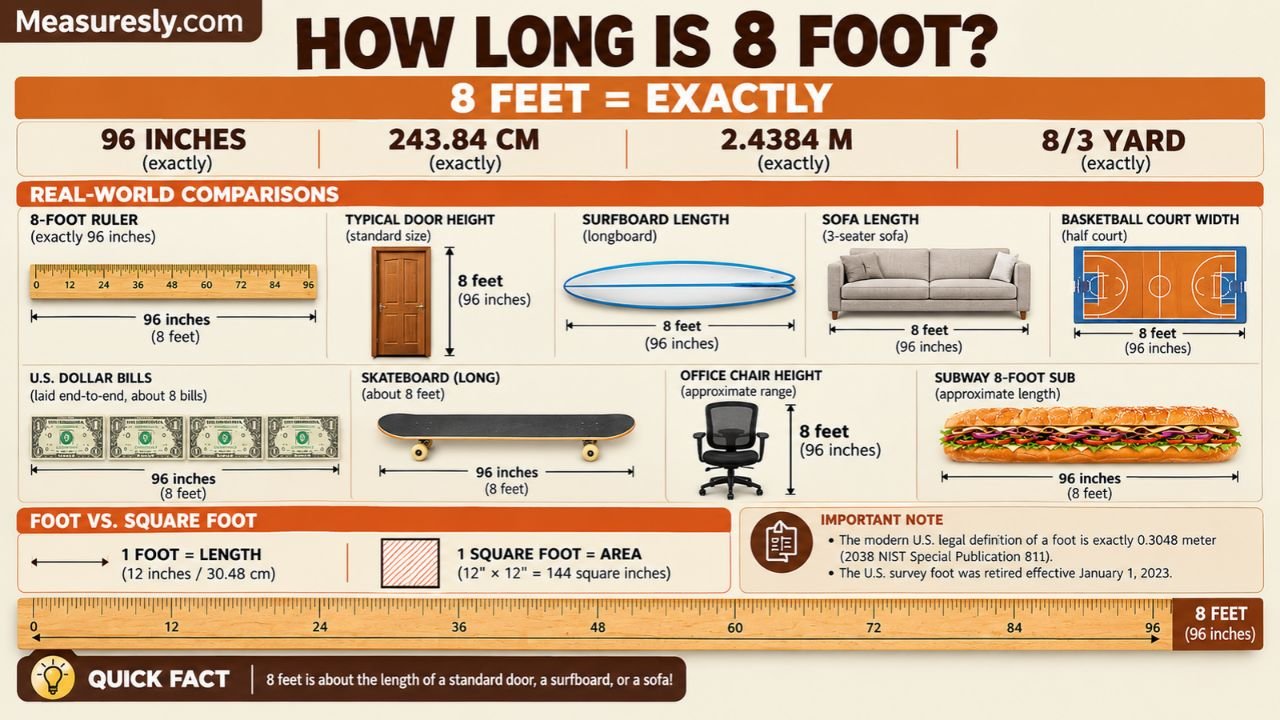

When someone asks “how long is 8 foot?”, they usually want more than a mathematical conversion. They may be trying to visualize an eight-foot table, check whether furniture will fit against a wall, understand a product dimension, estimate material requirements, or compare the measurement with something familiar.
The exact answer is simple:
8 feet = 96 inches = 243.84 centimeters = 2.4384 meters.
That makes eight feet slightly longer than 2.4 meters and exactly two feet longer than six feet.
However, there is an important difference between 8 feet, 8 linear feet, and 8 square feet. The first two describe length, while square feet describe area. Mixing them up can lead to incorrect calculations when buying flooring, countertops, fabric, furniture, or construction materials.
This guide explains the measurement from several angles, including practical object comparisons, conversion formulas, 5 Fruit by the Foot, 8 linear feet, 8 square feet, and the question of whether Subway offers an 8-foot Giant Sub.
The basic unit conversions in this guide follow the international definition of the foot used in modern measurement standards. [Reference Source: NIST, U.S. customary measurement standards]
Quick Answer: How Long Is 8 Feet?
If you only need the answer, here it is:
8 feet is exactly 96 inches.
In metric units:
- 8 feet = 243.84 centimeters
- 8 feet = 2.4384 meters
- 8 feet = 2,438.4 millimeters
- 8 feet = approximately 2.67 yards
The basic calculation is:
8 × 12 = 96 inches
And:
8 × 0.3048 = 2.4384 meters
The international foot is defined as exactly 0.3048 meter, while one foot contains 12 inches. [Reference Source: NIST / International System and U.S. Customary Units]
This means the conversion itself is exact. The only time rounding enters the picture is when you write the answer as approximately 2.44 meters or approximately 244 centimeters.
Understanding the Fundamentals of an 8-Foot Measurement
An eight-foot measurement represents a linear distance between two points.
Imagine dividing the entire length into eight equal sections:
1 ft + 1 ft + 1 ft + 1 ft + 1 ft + 1 ft + 1 ft + 1 ft = 8 ft
Since every foot contains 12 inches:
8 × 12 = 96 inches
This is why an object measuring 96 inches from one end to the other is exactly eight feet long.
For metric conversion:
1 foot = 30.48 cm
Therefore:
8 × 30.48 = 243.84 cm
Or:
243.84 cm ÷ 100 = 2.4384 m
[Reference Source: NIST, International Foot Definition]
The easiest mental shortcut
You do not have to memorize every conversion.
Remember these three relationships:
1 foot = 12 inches
1 foot = 30.48 centimeters
1 foot = 0.3048 meter
Then multiply each by eight.
This gives:
| Unit | 8-foot equivalent |
| Feet | 8 ft |
| Inches | 96 in |
| Centimeters | 243.84 cm |
| Meters | 2.4384 m |
| Millimeters | 2,438.4 mm |
| Yards | 2.67 yd approximately |
[Reference Source: NIST / Standard Unit Conversion Data]
How Long Is 8 Feet in Inches, CM and Meters?
8 Feet in Inches
This is the most common conversion people need.
There are 12 inches in one foot.
Therefore:
8 × 12 = 96
So:
8 feet = 96 inches
This is particularly useful when shopping online because furniture and home products are frequently listed in inches.
For example, if a product description says:
96″L × 30″W × 36″H
the “96” means the product is eight feet long.
It does not mean the item is eight feet wide or eight feet tall. Each dimension must be read separately.
[Reference Source: NIST / U.S. Customary Units
8 Feet in Centimeters
One foot equals 30.48 centimeters.
Therefore:
8 × 30.48 = 243.84 cm
So:
8 feet = 243.84 cm
For casual conversation, you can round this to 244 cm.
For technical work, furniture installation, construction, or product specifications, retain 243.84 cm unless the specification calls for rounding.
Current measurement-conversion references independently produce the same exact result of 243.84 cm. [Reference Source: NIST / CalculateMe conversion data]
8 Feet in Meters
The meter conversion is:
8 × 0.3048 = 2.4384 meters
Therefore:
8 feet = 2.4384 meters
In ordinary speech:
8 feet ≈ 2.44 meters
This makes it easy to understand the scale. Eight feet is a little more than two meters
8 Feet in Yards
One yard contains three feet.
So:
8 ÷ 3 = 2.6667 yards
Therefore:
8 feet ≈ 2.67 yards
Another way to describe it is:
2 yards + 2 feet
This can be useful when comparing measurements expressed in yards.
What Does 8 Feet Look Like in Real Life?
Knowing that eight feet equals 96 inches is mathematically useful, but most people search this question because they want to visualize the size.
Current search results for this topic frequently use furniture, building materials, room dimensions, ladders, tables, rugs, and other familiar objects as visual anchors. [Reference Source: Current SERP analysis for “how long is 8 feet”]
The important qualification is that real-world products vary. An “8-foot table,” for example, may be designed around an eight-foot nominal length, while other objects that look similar may be several inches shorter or longer.
So use the following comparisons to understand scale, not as substitutes for an actual tape measure.
1. An Eight-Foot Folding Table
An eight-foot folding or banquet table is one of the easiest horizontal references.
If the table is specified as eight feet long, its nominal length is:
8 feet = 96 inches
That gives you a strong visual representation of how much wall or floor length 96 inches occupies.
Tables of this size are commonly used for events, meetings, catering, parties, and temporary workspaces. Exact product dimensions can vary by manufacturer. [Reference Source: Manufacturer product specifications]
2. An Eight-Foot Building Panel
The 4 × 8-foot panel format is another familiar construction reference.
A panel measuring four feet by eight feet has:
- Length = 8 feet
- Width = 4 feet
Its surface area is:
8 × 4 = 32 square feet
This example demonstrates why length and area should not be confused.
The eight-foot side measures 96 inches, but the entire panel covers 32 square feet.
[Reference Source: Construction-material manufacturer specifications]
3. An Eight-Foot Ceiling
Eight feet is also a familiar vertical reference in residential construction.
However, avoid treating “8-foot ceiling” as a universal building requirement. Modern homes can have ceilings of many different heights, including 9, 10, or more feet.
An eight-foot ceiling simply provides an easy visualization:
Floor → ceiling = approximately 96 inches
If you stand beside an eight-foot vertical reference, you can immediately see that it is considerably taller than most adults.
Current measurement guides commonly use the eight-foot ceiling as a visualization example. [Reference Source: Current SERP comparison; verify local building specifications where applicable]
4. A Long Furniture Run
Imagine placing several furniture pieces along a wall until their combined width reaches 96 inches.
For example:
- 36-inch cabinet
- 24-inch cabinet
- 36-inch cabinet
Total:
36 + 24 + 36 = 96 inches
That equals:
8 feet
This is a more useful comparison for interior planning than simply imagining a number.
How Long Is 8 Linear Foot?
The phrase “how long is 8 linear foot” means eight feet measured along one dimension.
The answer is:
8 linear feet = 96 linear inches = 243.84 cm = 2.4384 meters
The word linear emphasizes that you are measuring a straight length.
This terminology is particularly common when buying:
- Countertops
- Trim
- Molding
- Carpet
- Fabric
- Fencing
- Shelving
- Cable
- Wire
- Baseboards
- Long construction materials
But there is a critical point:
Linear feet do not tell you the total surface area unless the width is also known.
Example: 8 Linear Feet of Countertop
Suppose a countertop is eight feet long and two feet wide.
Length:
8 linear feet
Width:
2 feet
Surface area:
8 × 2 = 16 square feet
So the same countertop can be described in two different ways:
8 linear feet long
and
16 square feet of surface area
Neither number replaces the other.
Why This Matters When Buying Materials
Imagine ordering “8 feet of flooring” without specifying width.
That information is incomplete because flooring products come in different widths.
For example:
Option A
8 ft × 1 ft
= 8 sq ft
Option B
8 ft × 2 ft
= 16 sq ft
Option C
8 ft × 3 ft
= 24 sq ft
All three are eight feet long, but their areas are completely different.
This is why professionals normally need both dimensions when calculating surface coverage.
How Long Is 8 Square Foot?
This is where many people make a measurement mistake.
8 feet and 8 square feet are not equivalent.
Eight feet is a length.
Eight square feet is an area.
A square foot represents an area of:
1 foot × 1 foot
Therefore:
1 sq ft = 144 sq in
So:
8 sq ft = 8 × 144 = 1,152 square inches
[Reference Source: NIST / U.S. customary area relationships]
But eight square feet does not have only one possible shape.
For example:
Shape A: 8 ft × 1 ft
8 × 1 = 8 sq ft
Shape B: 4 ft × 2 ft
4 × 2 = 8 sq ft
Shape C: 16 ft × 0.5 ft
16 × 0.5 = 8 sq ft
All three contain eight square feet.
This is the key lesson:
Square feet tell you how much surface exists, not how long one side must be.
5 Fruit by the Foot: How Long Are Five Rolls?
The secondary search query “how long is 5 Fruit by the Foot” refers to a packaged snack rather than a formal measurement unit.
A General Mills product specification for Fruit by the Foot describes an individual roll as bringing 3 feet of product. [Reference Source: General Mills / Syndigo Fruit by the Foot Product Specification]
Using that nominal product length:
1 roll ≈ 3 feet
Therefore:
5 rolls × 3 feet = 15 feet
So five rolls represent approximately:
15 feet
That is also:
- 180 inches
- 457.2 centimeters
- 4.572 meters
Here is the progression:
| Fruit by the Foot rolls | Approximate combined length |
| 1 | 3 ft |
| 2 | 6 ft |
| 3 | 9 ft |
| 4 | 12 ft |
| 5 | 15 ft |
There is an important E-E-A-T distinction here.
The three-foot figure is a product description, not a universal unit of measurement. Actual physical measurements can vary slightly depending on how the product is unrolled and whether folded or attached portions are included.
Therefore, for a consumer comparison, five rolls ≈ 15 feet is appropriate. It should not be presented as an engineering-grade measurement. [Reference Source: General Mills product specification / independent product measurements]
How Much Is 8 Foot Long at Subway?
The phrase “how much is 8 foot long at Subway” can be confusing because it may sound as though Subway sells a standard eight-foot sandwich.
The current Subway catering information reviewed for this guide lists:
- 3-foot Giant Sub
- 6-foot Giant Sub
The official Subway catering FAQ states that a 3-foot Giant Sub has 18 portions, while a 6-foot Giant Sub has 36 portions. Subway also requests advance notice for catering orders, although some same-day requests may be fulfilled. [Reference Source: Subway Official Catering FAQ]
The important point is:
Subway’s standard catering information does not list an 8-foot Giant Sub.
So you should not describe an eight-foot sandwich as a standard Subway menu item unless a specific local restaurant confirms a custom arrangement.
Comparing 8 Feet With Subway’s 6-Foot Giant Sub
The mathematical comparison is easy.
8 feet = 96 inches
6 feet = 72 inches
Difference:
96 − 72 = 24 inches
Therefore:
8 feet is 2 feet longer than 6 feet.
That means an eight-foot length is:
24 inches longer
than a six-foot length.
This is a useful way to visualize eight feet because Subway’s 6-foot Giant Sub provides a familiar commercial reference.
However, it is important not to turn this comparison into a claim that Subway sells an eight-foot Giant Sub.
[Reference Source: Subway Official Catering Information]
Read More: How Long Is 12 Inches? Exact Measurement, Conversions & Real-Life Comparisons
A Step-by-Step Way to Measure 8 Feet
If you need to physically mark an eight-foot distance, use this process.
Step 1: Start With a Stable Endpoint
Choose a clear starting point.
For furniture, this might be the edge of a wall.
For construction, it could be the beginning of a board.
For room planning, mark the starting position with removable tape.
Step 2: Measure 96 Inches
Because:
8 feet = 96 inches
extend your tape measure until the 96-inch mark.
Step 3: Check the Measurement Again
For practical projects, measure from the opposite direction where possible.
If both measurements agree, your result is more reliable.
Step 4: Account for Real-World Clearance
This is especially important for furniture.
If a sofa is exactly eight feet long, do not assume that an eight-foot wall provides comfortable installation space.
You may need additional clearance for:
- Door openings
- Side tables
- Wall gaps
- Electrical outlets
- Curtains
- Walking space
- Assembly
- Moving the item into the room
The mathematical dimension and the usable space are two different things.
Real-World Examples of an 8-Foot Measurement
Example 1: Furniture
You find a cabinet listed as:
96 inches long
Convert:
96 ÷ 12 = 8 feet
So the cabinet occupies eight feet of horizontal space.
Before buying, measure the wall and leave enough clearance for installation
Example 2: Countertop
A countertop is eight linear feet long and 25 inches wide.
Length:
8 feet
Width:
25 ÷ 12 = 2.0833 feet
Approximate area:
8 × 2.0833 = 16.67 square feet
This demonstrates why linear feet alone are not enough to determine surface area.
Example 3: Room Planning
Suppose you want to place a desk that is 96 inches wide against a wall.
The desk is exactly eight feet wide.
If the wall is 10 feet wide:
10 − 8 = 2 feet
You have two feet remaining.
That remaining space might be divided between both ends or reserved for other furniture.
Example 4: Product Comparison
Suppose Product A is 7 feet long and Product B is 8 feet long.
Difference:
8 − 7 = 1 foot
In inches:
1 × 12 = 12 inches
So Product B is exactly one foot, or 12 inches, longer.
Common Mistakes With 8 Feet and How to Avoid Them
Mistake 1: Confusing 8 Feet With 8 Square Feet
These describe different things.
Fix: Check whether the specification uses ft or sq ft / ft².
Mistake 2: Assuming 8 Linear Feet Gives You Area
Linear feet provide length only.
Fix: Multiply length by width when calculating area.
Area = length × width
Mistake 3: Treating “8-Foot” as an Exact Dimension Everywhere
A product described as eight feet may use a nominal size, while its actual manufactured dimensions can differ.
Fix: Check the manufacturer’s detailed specification before installation.
Mistake 4: Assuming Subway Has an 8-Foot Giant Sub
The current official Subway catering information reviewed for this guide lists 3-foot and 6-foot Giant Subs.
Fix: Verify the specific location if you need a custom or unusually large catering order. [Reference Source: Subway Official Catering FAQ]
Mistake 5: Using Everyday Objects as Measuring Instruments
A table or ceiling can help you visualize eight feet, but visual comparison is not precision measurement.
Fix: Use a tape measure whenever the exact fit matters.
8 Feet Compared With Nearby Measurements
A comparison table makes the difference easier to understand.
| Length | Inches | Centimeters | Meters |
| 6 feet | 72 | 182.88 | 1.8288 |
| 7 feet | 84 | 213.36 | 2.1336 |
| 8 feet | 96 | 243.84 | 2.4384 |
| 9 feet | 108 | 274.32 | 2.7432 |
| 10 feet | 120 | 304.80 | 3.0480 |
Notice the pattern:
Every additional foot adds:
12 inches
or:
30.48 centimeters
This makes mental conversion much easier.
Why 8 Feet Is Such a Useful Reference Measurement
Eight feet appears frequently in everyday dimensions because it is a convenient whole-number length and is closely associated with common construction, furniture, and material formats.
A four-foot section plus another four-foot section equals eight feet:
4 + 4 = 8 feet
Likewise:
2 yards + 2 feet = 8 feet
And:
96 inches = 8 feet
This gives you several mental shortcuts for estimating the distance without immediately reaching for a calculator.
In construction and interior planning, however, always distinguish between nominal dimensions and actual finished dimensions. Materials and finished products may be labeled using convenient standard sizes even when their measured dimensions differ slightly. [Reference Source: Manufacturer specifications / construction standards]
Future of Measurement and Digital Product Dimensions
Measurement searches are increasingly connected with online shopping, digital room planning, AR visualization, and automated product comparison.
Instead of simply reading “96 inches,” consumers can increasingly visualize whether an item will fit inside a room or doorway before purchasing it.
For SEO and answer-engine content, this also means a useful measurement article should provide more than one conversion. A strong answer should combine the exact figure, formulas, context, visual comparisons, practical warnings, and clearly identified sources.
The most trustworthy approach remains simple: use standardized conversions for the mathematical answer and manufacturer specifications for individual products.
Frequently Asked Questions About 8 Feet
Eight feet is exactly 96 inches, 243.84 centimeters, or 2.4384 meters.
Yes.
8 feet = 2.4384 meters.
Therefore, it is 0.4384 meter, or 43.84 centimeters, longer than two meters
There are 96 inches in eight feet.
The calculation is:
8 × 12 = 96
Eight feet equals 243.84 centimeters.
Eight feet equals 2.4384 meters, commonly rounded to 2.44 meters.
Eight linear feet means a straight length of 8 feet, which equals 96 inches or 243.84 centimeters.
Eight square feet is an area, not a single length.
It equals:
1,152 square inches
Possible dimensions include 8 ft × 1 ft or 4 ft × 2 ft.
Based on the product’s nominal three-foot format, five rolls equal approximately:
15 feet
or:
180 inches = 457.2 cm = 4.572 m
[Reference Source: General Mills / Syndigo Product Specification]
The current official Subway catering information reviewed for this article lists 3-foot and 6-foot Giant Subs, not a standard 8-foot Giant Sub. [Reference Source: Subway Official Catering FAQ]
Eight feet is 2 feet longer than six feet.
That equals:
24 inches
Yes.
8 feet = 96 inches exactly.
Final Answer: How Long Is 8 Foot?
The simplest answer to “how long is 8 foot?” is:
8 feet = 96 inches = 243.84 cm = 2.4384 meters.
For visualization, think of an eight-foot banquet table, an approximately eight-foot construction dimension, or a 96-inch furniture span. These references make the number easier to understand, although exact object dimensions should always be checked separately.
For the related measurements, 8 linear feet is still a length of 96 inches, while 8 square feet describes an area of 1,152 square inches. They should never be treated as interchangeable.
Five Fruit by the Foot rolls represent approximately 15 feet based on the product’s stated three-foot format. Subway’s official catering information reviewed for this guide lists 3-foot and 6-foot Giant Subs, rather than a standard eight-foot option.
When an exact measurement matters, use the standardized conversion first and then verify the actual product or space with a tape measure.
That combination—correct mathematics + real-world context + authoritative references—is the safest way to understand and apply an eight-foot measurement.
Read More: How Long Is 4 Foot? A Complete Guide to 4 Feet in Inches, CM and Meters
Aarav Choudhary
I’m Aarav Choudhary, a content researcher and technical writer with a strong interest in online calculators, unit conversion tools, and educational resources. At Measuresly, I focus on simplifying complex calculations into practical, reader-friendly content. Every article I write is thoroughly researched, fact-checked, and regularly updated to ensure accuracy and reliability.