

How Long Is 10 Foot?
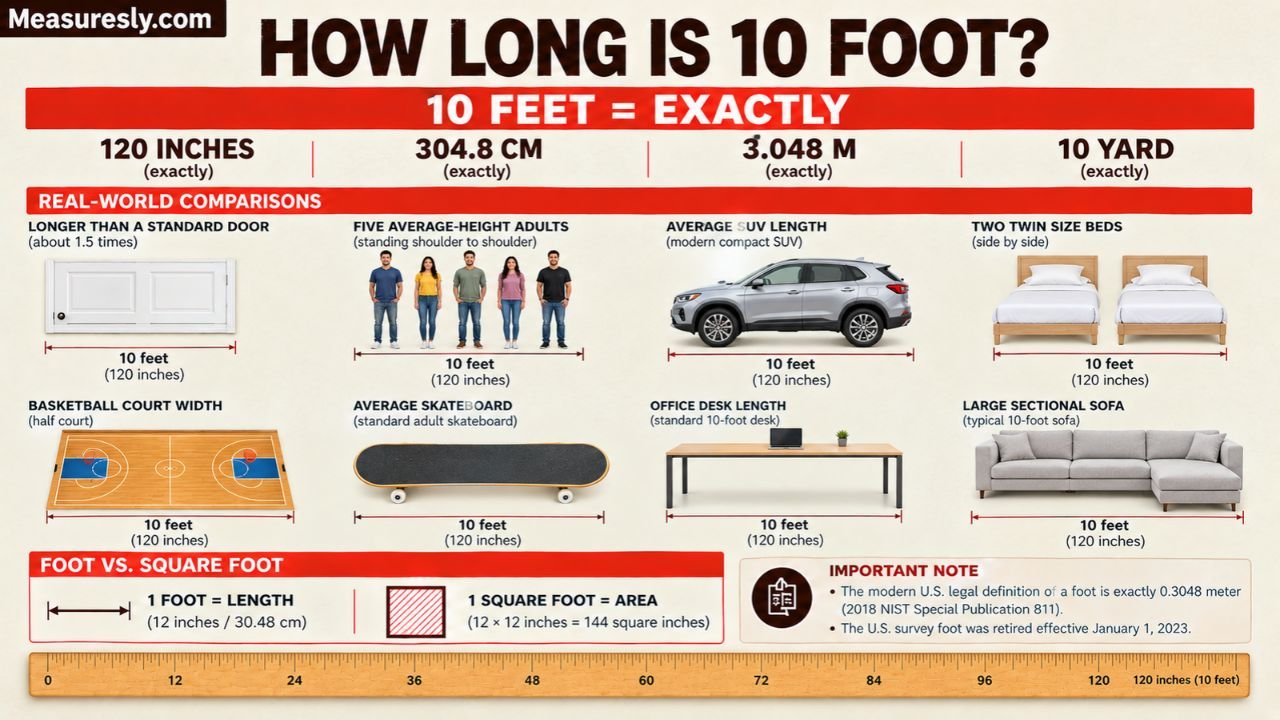
10 feet is exactly 120 inches, 304.8 centimeters, or 3.048 meters. It is also equal to 3⅓ yards. [Reference Source: NIST]
If you are trying to picture 10 feet in real life, imagine a straight line slightly longer than three meters. Another useful visual reference is a regulation basketball rim: the rim is positioned 10 feet above the playing floor under standard basketball rules. [Reference Source: FIBA / NBA]
But “10 feet” can mean different things depending on what you are measuring. A 10-foot-long board is a length. 10 linear feet is also a length, while 10 square feet describes an area. They are not interchangeable.
This guide answers the most common questions surrounding how long is 10 foot, including its size in inches and centimeters, how to visualize it, how 5 Fruit by the Foot compares with 10 feet, what 10 linear feet means, how large 10 square feet is, and whether Subway currently sells a 10-foot sandwich.
How Long Is 10 Feet in Inches, Centimeters, Meters and Yards?
The quickest answer is:
| Measurement | Equivalent to 10 feet |
| Inches | 120 inches |
| Centimeters | 304.8 cm |
| Millimeters | 3,048 mm |
| Meters | 3.048 m |
| Yards | 3⅓ yards |
| Feet | 10 ft |
[Reference Source: NIST Handbook 44 / NIST Guide to the SI]
The calculations are straightforward.
10 feet to inches
There are exactly 12 inches in one international foot.
10 × 12 = 120 inches
Therefore:
10 feet = 120 inches
[Reference Source: NIST]
10 feet to centimeters
One international foot equals exactly 30.48 centimeters.
10 × 30.48 = 304.8 cm
Therefore:
10 feet = 304.8 centimeters
[Reference Source: NIST]
10 feet to meters
One foot equals exactly 0.3048 meters.
10 × 0.3048 = 3.048 meters
Therefore:
10 feet = 3.048 meters
[Reference Source: NIST]
10 feet to yards
One yard contains three feet.
10 ÷ 3 = 3⅓ yards
So:
10 feet = 3.333… yards
[Reference Source: NIST]
What Does 10 Feet Look Like in Real Life?
Numbers are easy to calculate but sometimes difficult to visualize.
Ten feet is long enough to represent a noticeable distance across a room, but it is short enough to measure with a normal tape measure.
One of the easiest ways to understand it is to use a 10-foot tape measure. Pull the tape completely straight and mark the 10-foot point. You now have a practical reference that can be compared with furniture, walls, vehicles, sports equipment or outdoor spaces.
Another excellent reference is a basketball hoop.
The standard basketball rim height is 10 feet from the playing surface. [Reference Source: NBA / FIBA]
This means that if you stand underneath a regulation basketball basket and look from the floor to the rim, you are looking at approximately the same vertical distance as 10 feet.
Is 10 Feet Longer Than an Average Person Is Tall?
For most adults, yes.
A person who is approximately 5 feet 5 inches to 6 feet tall is substantially shorter than a 10-foot distance. The exact comparison depends on the individual’s height, so it should be treated as a visual approximation rather than a measurement standard.
For example:
- A 5-foot person would need another 5 feet to reach 10 feet.
- A 6-foot person would need another 4 feet.
- A 6-foot-2-inch person would still need 3 feet 10 inches.
This is why two adults standing one above another is not a precise measuring method. A tape measure is more reliable.
Read More : How Long Is 8 Foot? Complete Guide to 8 Feet in Inches, CM, Linear Feet & More
How Long Is 10 Feet Compared With Common Objects?
The best visual comparisons are objects whose dimensions are known or relatively standardized.
A few useful examples include:
A Basketball Rim
A regulation basketball rim is 10 feet above the floor.
This is one of the strongest real-world references because the measurement is governed by official basketball rules. [Reference Source: NBA / FIBA]
A 10-Foot Board
A board specifically sold as 10 feet long provides an obvious physical comparison. However, lumber is often sold using nominal dimensions, so its width and thickness may not equal the dimensions suggested by its product name.
A 10-Foot Room Dimension
A room measuring 10 feet from one wall to another has a length of 120 inches.
For example, a room could measure:
10 ft × 12 ft = 120 square feet
Notice the difference: the 10-foot measurement is a length, while 120 square feet is the resulting area.
A 10-Foot Ceiling
A ceiling 10 feet above the floor is approximately 3.048 meters high. This is noticeably taller than an 8-foot ceiling.
The important point is that “10 feet” can describe height, width or length. The unit itself does not tell you the direction being measured.
How Long Is 10 Linear Foot?
10 linear feet means a continuous length of 10 feet, or 120 inches.
The word “linear” is important because it tells you that you are measuring one dimension.
For example:
- A 10-foot-long board = 10 linear feet.
- A 10-foot strip of trim = 10 linear feet.
- Ten feet of cable = 10 linear feet.
- Ten feet of countertop material = 10 linear feet.
[Reference Source: NIST / standard dimensional measurement practice]
Is 10 Linear Feet the Same as 10 Square Feet?
No.
This is one of the most common measurement mistakes.
Linear feet measure length.
Square feet measure area.
Suppose you have a countertop that is 10 feet long and 2 feet wide.
Its linear length is:
10 linear feet
Its surface area is:
10 × 2 = 20 square feet
So the same object can have 10 linear feet of length and 20 square feet of surface area.
How Do You Convert 10 Linear Feet Into Square Feet?
You need to know the width.
The basic formula is:
Square feet = Linear feet × Width in feet
For 10 linear feet:
Square feet = 10 × width
Examples:
| Length | Width | Area |
| 10 ft | 1 ft | 10 sq ft |
| 10 ft | 2 ft | 20 sq ft |
| 10 ft | 3 ft | 30 sq ft |
| 10 ft | 4 ft | 40 sq ft |
| 10 ft | 5 ft | 50 sq ft |
[Reference Source: NIST / standard area calculation]
This is especially useful when purchasing flooring, countertops, fabric, carpet, lumber or other materials sold by length.
How Long Is 10 Square Foot?
Strictly speaking, 10 square feet is not a length.
It is an area.
One square foot is an area measuring 1 foot by 1 foot. Therefore, 10 square feet can have many different shapes.
For example:
1 ft × 10 ft = 10 square feet
But:
2 ft × 5 ft = 10 square feet
Both contain exactly 10 square feet even though they have different dimensions.
What Does 10 Square Feet Look Like?
One easy way to visualize 10 square feet is a rectangle measuring:
2 feet wide × 5 feet long
because:
2 × 5 = 10 square feet
Another possibility is approximately a 3.16-foot × 3.16-foot square, because:
√10 ≈ 3.162 feet
However, most real-world spaces are rectangles rather than perfect squares.
How Many Square Inches Are 10 Square Feet?
One square foot contains:
12 × 12 = 144 square inches
Therefore:
10 × 144 = 1,440 square inches
So:
10 square feet = 1,440 square inches
[Reference Source: NIST]
How Many Square Meters Is 10 Square Feet?
NIST’s approximate conversion table gives 1 square foot as approximately 0.0929 square meter. [Reference Source: NIST]
Therefore:
10 square feet ≈ 0.929 square meters
This is useful when converting American or British-style measurements into metric measurements.
How Long Is 5 Fruit by the Foot?
A standard Fruit by the Foot is marketed by General Mills as providing approximately three feet of fun.
[Reference Source: General Mills]
Therefore, if you have five standard Fruit by the Foot rolls and place them end-to-end:
5 × 3 feet = 15 feet
So:
5 Fruit by the Foot ≈ 15 feet
That is 5 feet longer than 10 feet.
In inches:
15 × 12 = 180 inches
In centimeters:
15 × 30.48 = 457.2 cm
Therefore:
Five standard Fruit by the Foot rolls ≈ 15 feet = 180 inches = 457.2 cm.
How Does 5 Fruit by the Foot Compare With 10 Feet?
This makes for an interesting visual comparison.
| Item | Approximate length |
| 10-foot measurement | 10 ft |
| 1 Fruit by the Foot | 3 ft |
| 2 Fruit by the Foot | 6 ft |
| 3 Fruit by the Foot | 9 ft |
| 4 Fruit by the Foot | 12 ft |
| 5 Fruit by the Foot | 15 ft |
[Reference Source: General Mills]
So three standard Fruit by the Foot rolls would be approximately 9 feet long, while four would reach approximately 12 feet.
That means 10 feet is slightly longer than three standard Fruit by the Foot rolls but shorter than four.
The product is marketed around the three-foot concept, so actual physical length should not be treated as a precision measuring instrument. Product versions and packaging can vary.
How Much Is 10 Foot Long at Subway?
This question requires an important clarification.
Subway does not currently list a standard 10-foot Giant Sub on the official catering page reviewed for this article.
The Subway catering information currently lists:
- 3-foot Giant Sub — 18 two-inch portions, serving approximately 9–15 people.
- 6-foot Giant Sub — 36 two-inch portions, serving approximately 18–25 people.
Subway also states that measurements are approximate and that Giant Sub orders require advance notice. [Reference Source: Subway official catering]
Therefore, it would be misleading to say that Subway currently has a standard 10-foot sandwich without confirming availability at a particular restaurant.
How Much Subway Food Would Equal 10 Feet?
For a simple length comparison, 10 feet equals:
120 inches
A traditional Subway “Footlong” is named for a 12-inch class of sandwich, although Subway’s official product descriptions and legal terminology can vary by market and product. Therefore, it is better not to treat the “Footlong” name as a guaranteed measured 12-inch physical length in every context.
As a mathematical comparison only:
10 feet ÷ 1 foot = 10 foot-length units
But that does not mean Subway currently sells a product made from exactly ten individually measured Footlong sandwiches.
What Is the Closest Official Subway Giant Sub?
The closest official size currently listed is the 6-foot Giant Sub.
Subway’s official catering information says that the 6-foot version contains 36 two-inch portions and serves approximately 18–25 people. [Reference Source: Subway official catering]
To reach 10 feet mathematically from 6 feet, you would need another:
10 − 6 = 4 feet
However, that is only a mathematical comparison—not a statement that Subway offers a 10-foot Giant Sub.
How Do You Measure 10 Feet Accurately?
If accuracy matters, use a tape measure rather than estimating with body length or walking steps.
Step 1: Choose the Starting Point
Place the beginning of your tape at the exact point where the measurement should start.
Step 2: Keep the Tape Straight
A curved or sagging tape can produce an incorrect result.
For horizontal measurements, keep the tape close to the surface.
Step 3: Find the 10-Foot Mark
Ten feet corresponds to:
120 inches
Look for the 10-foot marking or count to 120 inches.
Step 4: Mark the Endpoint
Use chalk, painter’s tape or another suitable marker.
Step 5: Double-Check
Measure again from the same starting point.
For important construction or installation work, do not rely on a single casual measurement
What Are Some Practical Uses for a 10-Foot Measurement?
Ten feet appears in many practical situations.
Home Improvement
You may need a 10-foot measurement when planning:
- Countertops
- Flooring
- Wall sections
- Curtains
- Shelving
- Electrical cable
- Garden edging
- Trim
- Furniture placement
The crucial distinction is whether the material is priced by linear foot or square foot.
Outdoor Planning
Ten feet can be useful for estimating:
- Fence sections
- Garden layouts
- Patio dimensions
- Canopy sizes
- Outdoor furniture spacing
- Walkway distances
Sports
The basketball rim provides one of the strongest standardized 10-foot references.
[Reference Source: NBA / FIBA]
Events and Decorations
A 10-foot measurement may also be used when planning banners, backdrops, lighting, table arrangements and temporary structures.
Real-World Examples: Understanding 10 Feet Visually
Imagine you are buying a 10-foot-long shelf.
The shelf needs to fit along a wall that is 11 feet wide.
Your available wall length is:
11 feet = 132 inches
Your shelf length is:
10 feet = 120 inches
Remaining space:
132 − 120 = 12 inches
Therefore, you have approximately 1 foot of remaining wall space.
Now consider a different situation.
You have a rectangular rug area that measures 10 feet by 8 feet.
Its area is:
10 × 8 = 80 square feet
The 10-foot dimension describes the length, while 80 square feet describes the total area.
This example demonstrates why confusing feet, linear feet and square feet can produce expensive planning errors
What Is the Difference Between 10 Feet, 10 Linear Feet and 10 Square Feet?
The easiest explanation is:
| Term | What it measures | Example |
| 10 feet | Length | A 10-ft board |
| 10 linear feet | Length along one dimension | 10 ft of countertop |
| 10 square feet | Area | 2 ft × 5 ft surface |
| 10 cubic feet | Volume | 2 × 2 × 2.5 ft space |
The first two are essentially length measurements in common usage.
Square feet are different because they describe two-dimensional space.
Cubic feet are different again because they describe volume.
This distinction becomes particularly important when ordering materials
Common Mistakes When Measuring 10 Feet
Mistake 1: Confusing Feet With Square Feet
A 10-foot board is not automatically 10 square feet.
You need its width.
Mistake 2: Assuming a Brand Name Is an Exact Measurement
Products such as “Footlong” sandwiches are product names and should not automatically be treated as laboratory measurements.
Mistake 3: Using Walking Steps as an Exact Method
People have different stride lengths. Steps are useful for rough estimation but not precision work.
Mistake 4: Forgetting Width
If you are converting linear feet into square feet, width is essential.
10 linear feet alone cannot determine an area.
Mistake 5: Treating Fruit by the Foot as a Precision Measuring Tool
General Mills markets the standard snack around three feet, but food products are not manufactured as precision surveying equipment.
[Reference Source: General Mills]
How Can You Estimate 10 Feet Without a Tape Measure?
If you do not have a measuring tape, you can create a rough estimate using known objects.
For example:
- Three feet is approximately one yard.
- Ten feet is 3⅓ yards.
- A regulation basketball rim is 10 feet high.
- 120 inches equals 10 feet.
You can also use a known-length object repeatedly, but remember that this is an approximation.
For professional construction, installation, furniture fitting or safety-related work, use an appropriate measuring device.
Is 10 Feet the Same as 3 Meters?
Not exactly.
Ten feet equals:
3.048 meters
Three meters equals:
9.8425 feet
Therefore, 10 feet is approximately 4.8 centimeters longer than 3 meters.
This difference may be irrelevant for casual visualization but important for precise construction or engineering.
[Reference Source: NIST]
Is 10 Feet a Long Distance?
It depends on context.
For walking, 10 feet is a short distance.
For a room, 10 feet is a substantial wall-to-wall dimension.
For height, 10 feet is quite tall.
For a piece of furniture, 10 feet is exceptionally long.
For a sports measurement, 10 feet can be a standardized distance or height.
So whether 10 feet feels “long” depends on what you are measuring.
What Is the Best Mental Shortcut for 10 Feet?
If you need one simple mental image, remember:
10 feet = 120 inches = 3.048 meters = basketball-rim height.
For horizontal length, imagine a straight 10-foot tape measure stretched across a floor.
For food comparisons, five standard Fruit by the Foot rolls are approximately 15 feet in total, making them noticeably longer than a 10-foot distance. [Reference Source: General Mills]
For Subway, remember that the current official catering information reviewed lists 3-foot and 6-foot Giant Subs—not a standard 10-foot Giant Sub. [Reference Source: Subway official catering]
What Are the Most Important Facts About 10 Feet?
Here is the complete quick-reference guide:
| Question | Answer |
| How long is 10 feet? | 10 feet |
| 10 feet in inches | 120 inches |
| 10 feet in centimeters | 304.8 cm |
| 10 feet in meters | 3.048 m |
| 10 feet in yards | 3⅓ yards |
| 10 linear feet | 120 inches of length |
| 10 square feet | Area, not length |
| 10 sq ft in sq inches | 1,440 sq in |
| 5 Fruit by the Foot | About 15 feet |
| Current Subway 10-ft Giant Sub | Not listed on the official catering page reviewed |
| Current Subway Giant Sub sizes listed | 3 ft and 6 ft |
[Reference Source: NIST / General Mills / Subway official]
Frequently Asked Questions About How Long Is 10 Foot
Ten feet equals 120 inches, 304.8 centimeters, and 3.048 meters. [Reference Source: NIST]
10 feet = 120 inches.
The calculation is 10 × 12 = 120. [Reference Source: NIST]
10 feet = 304.8 centimeters. [Reference Source: NIST]
10 feet = 3.048 meters. [Reference Source: NIST]
10 feet = 3⅓ yards, or approximately 3.33 yard
Ten linear feet means 10 feet of one-dimensional length, equal to 120 inches.
No. Linear feet measure length, while square feet measure area.
A 10-foot-long material that is 2 feet wide covers 20 square feet.
Ten square feet is an area, not a length. For example, a rectangle measuring 2 feet × 5 feet has an area of 10 square feet.
There are 1,440 square inches in 10 square feet.
The calculation is 10 × 144 = 1,440.
A standard Fruit by the Foot is marketed by General Mills as approximately three feet long. Therefore, five standard rolls total approximately 15 feet when placed end-to-end. [Reference Source: General Mills]
Yes. Five standard Fruit by the Foot rolls would total approximately 15 feet, which is about 5 feet longer than 10 feet. [Reference Source: General Mills]
Using the advertised three-foot length:
10 ÷ 3 = 3⅓ Fruit by the Foot rolls
In practical terms, three rolls are about 9 feet and four rolls are about 12 feet.
Subway’s current official catering page reviewed for this guide does not list a standard 10-foot Giant Sub. It lists 3-foot and 6-foot Giant Subs. [Reference Source: Subway official catering]
The official catering information reviewed lists a 6-foot Giant Sub, containing 36 two-inch portions and serving approximately 18–25 people. Subway notes that measurements are approximate. [Reference Source: Subway official catering]
A standard 10-foot Giant Sub is not listed on the official Subway catering page reviewed. Availability can vary by market and restaurant, so you would need to contact a local participating restaurant for any custom request.
No. Ten feet is 3.048 meters, so it is 0.048 meter longer than 3 meters. [Reference Source: NIST]
Ten feet can describe a height of 10 feet. A useful standardized example is the basketball rim, which is positioned 10 feet above the playing floor under official basketball rules. [Reference Source: NBA / FIBA]
Think of a straight 10-foot tape measure, or picture the vertical distance from a basketball court floor to a regulation rim.
The number varies according to a person’s stride length, so there is no universal exact step count. Use steps only for rough estimation.
If a product is sold as a 10-foot board, its nominal or labeled dimension may not represent every physical dimension or manufacturing tolerance. For precision projects, verify the manufacturer’s specifications and measure the actual piece.
The numerical distance is identical, but your visual perception changes depending on orientation and surroundings. Ten feet horizontally across a room can feel different from ten feet vertically above the floor.
Conclusion: How Long Is 10 Foot?
So, how long is 10 foot?
The precise answer is:
10 feet = 120 inches = 304.8 centimeters = 3.048 meters = 3⅓ yards. [Reference Source: NIST]
For practical comparisons, 10 feet is the same vertical height as a regulation basketball rim. Five standard Fruit by the Foot rolls represent approximately 15 feet when placed end-to-end, based on General Mills’ three-foot product description. [Reference Source: General Mills]
For 10 linear feet, think about length. For 10 square feet, think about area. And when it comes to Subway, the current official catering information reviewed lists 3-foot and 6-foot Giant Subs rather than a standard 10-foot option. [Reference Source: Subway]
Whether you’re measuring a room, planning a DIY project, comparing food lengths or simply trying to understand the size, remembering 10 feet = 120 inches gives you the quickest reliable starting point.
Save this guide for future feet-to-inch, centimeter and square-foot calculations, and always verify product-specific dimensions before making a purchase or installation decision.
Read More : How Long Is 4 Foot? A Complete Guide to 4 Feet in Inches, CM and Meters
How Long Is 9 Foot? Complete Guide to 9 Feet in Inches, CM, Linear Feet & More
Aarav Choudhary
I’m Aarav Choudhary, a content researcher and technical writer with a strong interest in online calculators, unit conversion tools, and educational resources. At Measuresly, I focus on simplifying complex calculations into practical, reader-friendly content. Every article I write is thoroughly researched, fact-checked, and regularly updated to ensure accuracy and reliability.