
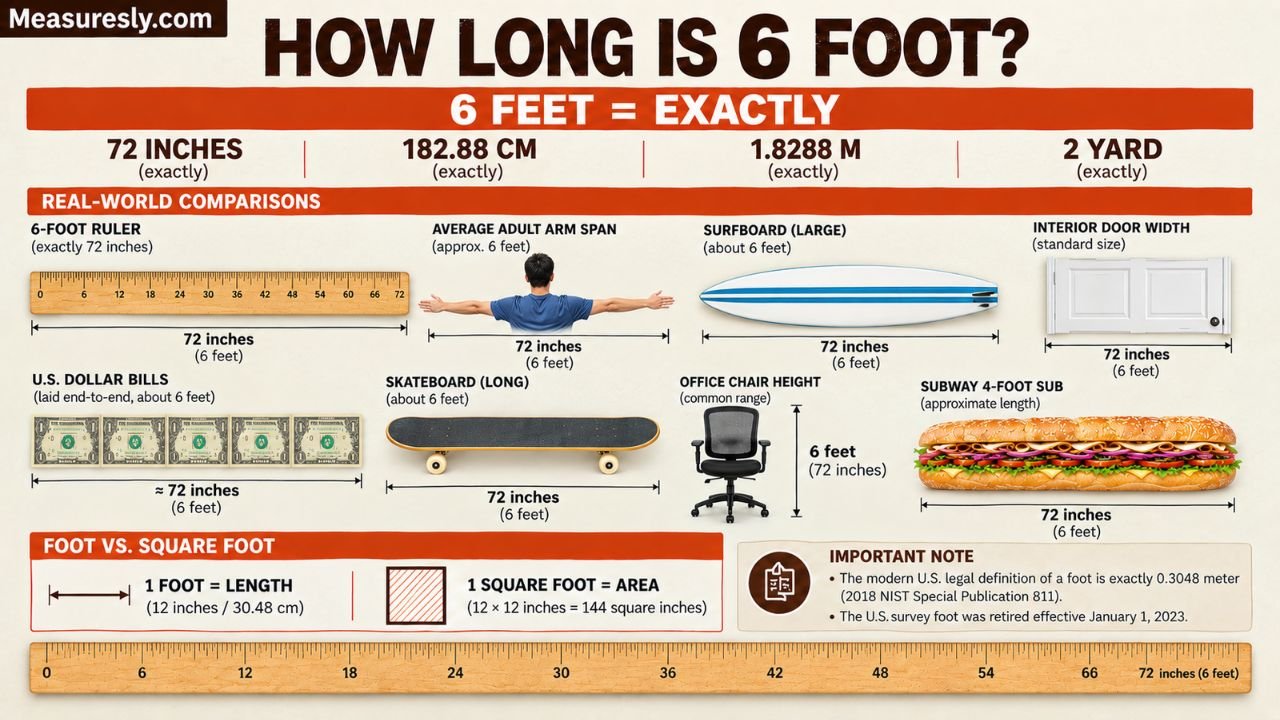

Introduction: How Long Is 6 Foot?
If you are wondering how long is 6 foot, the exact measurement is straightforward:
6 feet = 72 inches = 182.88 centimeters = 1.8288 meters.
It is also exactly 2 yards.
That answers the mathematical part of the question, but many people searching for six feet are actually trying to understand its physical size. You might be checking the dimensions of a table, comparing furniture, measuring a wall, estimating the length of a material, understanding someone’s height, or simply trying to picture what 72 inches looks like.
There are also several related searches that can cause confusion. 6 linear feet refers to a straight-line length, while 6 square feet refers to an area. Five Fruit by the Foot rolls represent a completely different product measurement, while a 6-foot Subway Giant Sub is an actual catering product size.
This guide separates all of these meanings and gives you exact conversions, formulas, practical examples, measurement tips, and answers to the questions people commonly ask.
[Reference Source: NIST / International System of Units conversion standards]
6 Feet: The Exact Answer at a Glance
If you only need the conversion, save this table:
| Unit | Equivalent to 6 Feet |
| Inches | 72 inches |
| Centimeters | 182.88 cm |
| Meters | 1.8288 m |
| Millimeters | 1,828.8 mm |
| Yards | 2 yards |
| Kilometers | 0.0018288 km |
The basic calculation is based on two exact relationships.
Feet to inches
One foot contains 12 inches.
6 × 12 = 72 inches
Feet to meters
The international foot is exactly 0.3048 meter.
6 × 0.3048 = 1.8288 meters
Meters to centimeters
One meter contains 100 centimeters.
1.8288 × 100 = 182.88 centimeters
So, whenever you see a dimension of 72 inches, you can immediately recognize it as 6 feet.
Likewise, a specification of 182.88 cm represents exactly the same length.
[Reference Source: NIST Guide to the SI / NIST Handbook 44]
What Does 6 Feet Actually Mean?
A foot is a unit of length. Therefore, six feet describes a distance from one point to another.
The orientation does not matter.
Six feet could represent:
- The length of a table
- The height of a person
- The width of a wall section
- The length of a board
- The length of a shelf
- The distance between two points
- The nominal length of a catering sandwich
What changes is the context.
For example, a table could be:
6 feet long × 2 feet wide
while a storage board could be:
6 feet long × 4 inches wide
Both objects are six feet long, but they have dramatically different widths.
This is why a length measurement should not be confused with the complete dimensions of an object.
When buying furniture, the useful information is usually:
Length × Width × Height
When calculating material coverage, you may instead need:
Length × Width = Area
That distinction becomes particularly important when comparing 6 feet, 6 linear feet, and 6 square feet.
[Reference Source: Standard dimensional and geometric measurement principles]
How Long Is 6 Feet in Inches?
Six feet equals exactly 72 inches.
The formula is:
Feet × 12 = Inches
For six feet:
6 × 12 = 72
Therefore:
6 feet = 72 inches
This conversion is particularly useful because many furniture, home-improvement, electronics, and construction specifications are presented in inches.
For example, if a product listing says:
72 inches wide
you can convert it immediately:
72 ÷ 12 = 6 feet
Nearby measurements
| Length | Inches |
| 3 feet | 36 inches |
| 4 feet | 48 inches |
| 5 feet | 60 inches |
| 6 feet | 72 inches |
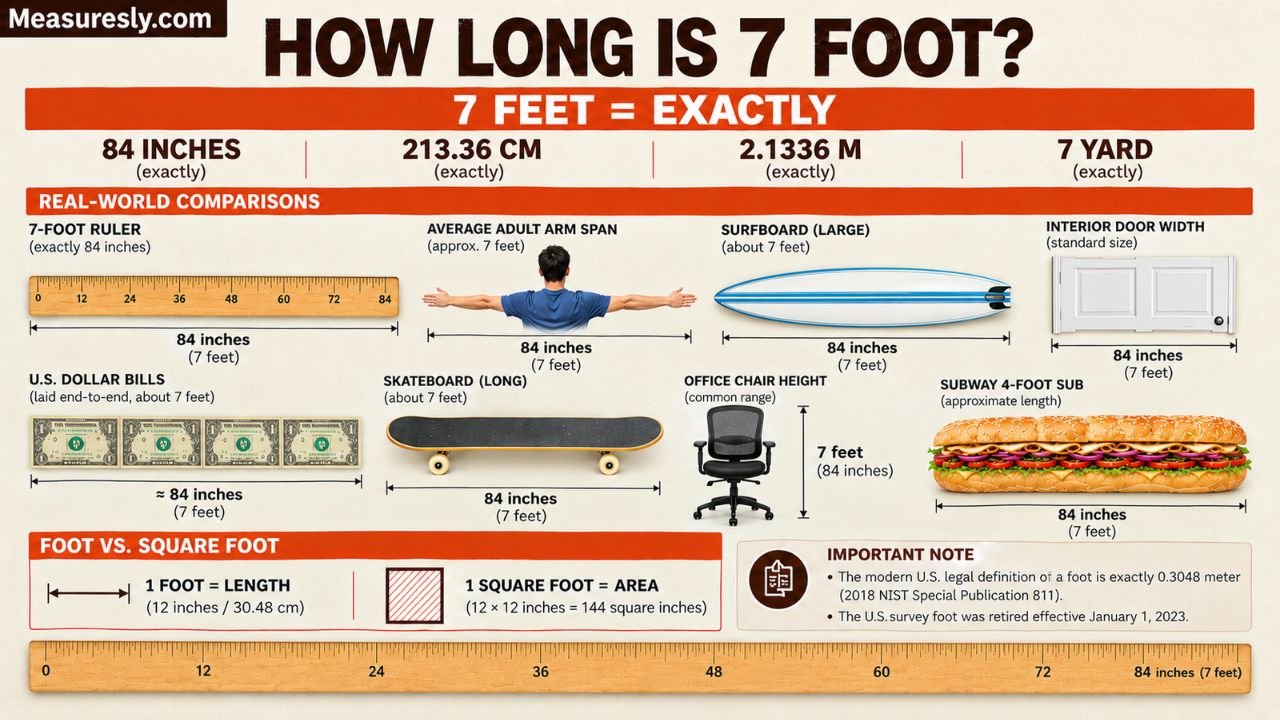
| 7 feet | 84 inches |
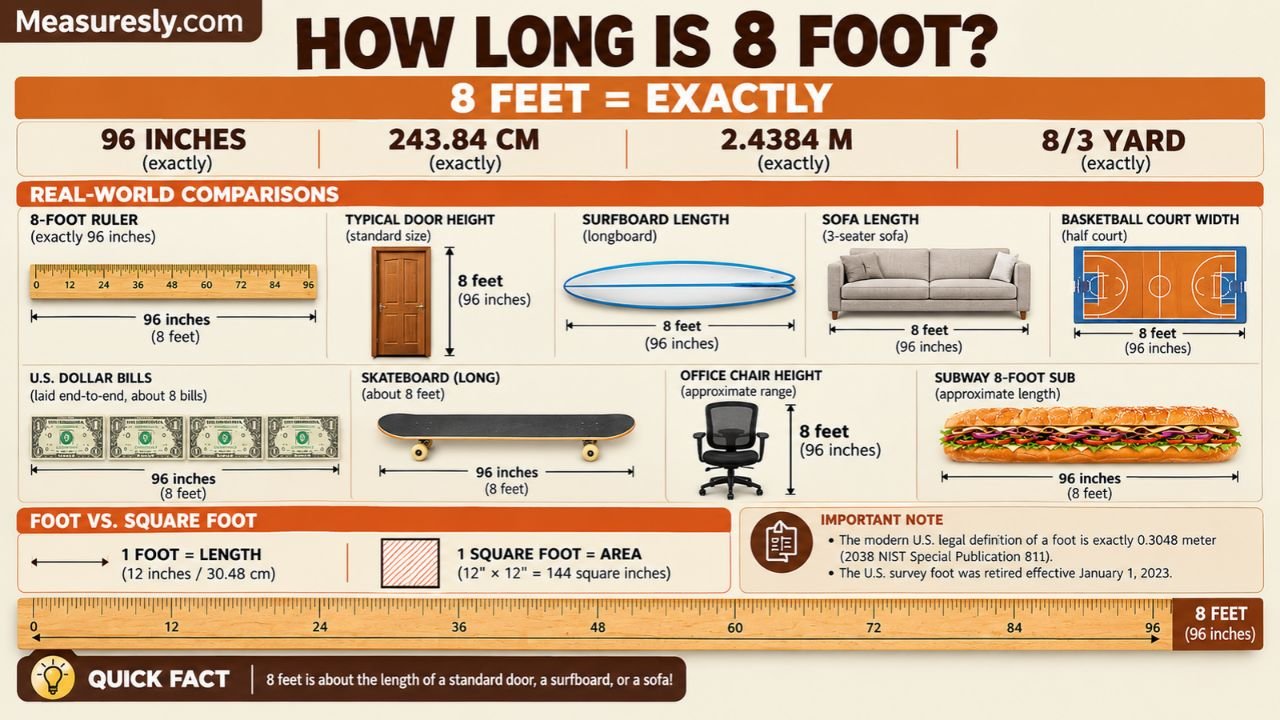
| 8 feet | 96 inches |
A simple mental method is to imagine six separate one-foot sections placed end to end.
Each section contributes 12 inches:
12 + 12 + 12 + 12 + 12 + 12 = 72 inches
[Reference Source: NIST measurement conversion standards]
How Long Is 6 Feet in Centimeters?
Six feet equals exactly 182.88 centimeters.
You can calculate it in two steps.
First:
6 feet × 12 = 72 inches
Then:
72 inches × 2.54 = 182.88 centimeters
Therefore:
6 feet = 182.88 cm
For everyday communication, people often round this to 183 cm.
That rounded number is convenient, but it is not the exact conversion.
If a form, technical specification, or measurement calculation requires precision, use:
182.88 cm
The same value can also be written as:
1.8288 meters
[Reference Source: NIST / exact international inch and foot definitions]
How Long Is 6 Feet in Meters?
The precise metric equivalent is:
6 feet = 1.8288 meters
The conversion formula is:
Feet × 0.3048 = meters
So:
6 × 0.3048 = 1.8288 m
For quick estimates, you can round this to:
1.83 meters
That is useful when talking about everyday objects, room dimensions, or approximate height.
However, there is a meaningful difference between the rounded and exact values:
- Exact: 1.8288 m
- Rounded to two decimal places: 1.83 m
Six feet is also less than two meters by:
2.0000 − 1.8288 = 0.1712 meter
That equals 17.12 centimeters.
So if you picture a two-meter distance, six feet is about 17 centimeters shorter.
[Reference Source: NIST Guide to the SI]
Is 6 Feet the Same as 2 Yards?
Yes.
This conversion is exact.
A yard contains three feet:
1 yard = 3 feet
Therefore:
6 ÷ 3 = 2 yards
So:
6 feet = 2 yards
This gives you another useful way to visualize the distance.
| Measurement | Equivalent |
| 1 yard | 3 feet |
| 2 yards | 6 feet |
| 3 yards | 9 feet |
| 4 yards | 12 feet |
If a measurement is described as two yards, you can immediately translate it into six feet.
[Reference Source: NIST Handbook 44]
What Does 6 Feet Look Like?
This is where a pure conversion page often stops being useful.
Most people can understand 72 inches mathematically, but they may still wonder what that distance looks like in a room.
The easiest solution is to use physical references.
Six One-Foot Sections
Imagine six pieces of string, each exactly one foot long.
Put them together:
1 + 1 + 1 + 1 + 1 + 1 = 6 feet
This is a reliable mental model because each piece has a defined length.
Six 12-Inch Rulers
If you have a standard 12-inch ruler, six ruler lengths placed end to end equal:
72 inches
This is more accurate than comparing six feet with an arbitrary household object.
A Six-Foot Folding Table
A six-foot folding table is another useful real-world reference. Many commercial folding tables are designed around a 72-inch length, although exact dimensions vary by manufacturer.
If you are using a table as a visual comparison, treat it as an example rather than a universal six-foot standard.
[Reference Source: Individual furniture manufacturer specifications]
A Wall Section
Mark one point on a wall.
Measure exactly 72 inches horizontally.
The distance between the two points is six feet.
This is an especially useful visualization when planning.
How Long Is 6 Linear Foot?
The search phrase “how long is 6 linear foot” generally refers to 6 linear feet.
A linear foot is simply a one-dimensional measurement of length.
Therefore:
6 linear feet = 6 feet = 72 inches
Adding the word “linear” does not change the distance.
It clarifies that the measurement concerns one straight-line dimension.
For example, if a supplier tells you that you need six linear feet of trim, the length requirement is:
72 inches
But there is another piece of information you may need: the width of the trim.
This is because linear feet tell you how long the material is, not how much surface area it covers.
Example
Suppose a material is:
6 linear feet long
and:
2 feet wide
Its surface area is:
6 × 2 = 12 square feet
If the same six-foot length were four feet wide:
6 × 4 = 24 square feet
The length has not changed.
The coverage has.
[Reference Source: Standard material and area calculation principles]
How to Calculate Square Feet From 6 Linear Feet
This is a common source of confusion.
You cannot determine square footage from six linear feet alone.
You need the width.
Use this formula:
Area in square feet = Linear feet × Width in feet
For six linear feet:
Area = 6 × Width
Here are some examples:
| Width | Length | Resulting Area |
| 1 foot | 6 linear feet | 6 sq ft |
| 1.5 feet | 6 linear feet | 9 sq ft |
| 2 feet | 6 linear feet | 12 sq ft |
| 3 feet | 6 linear feet | 18 sq ft |
| 4 feet | 6 linear feet | 24 sq ft |
| 5 feet | 6 linear feet | 30 sq ft |
This calculation is useful for materials such as:
- Countertops
- Carpet
- Fabric
- Flooring
- Vinyl
- Wall materials
- Certain lumber products
If the width is supplied in inches, convert it to feet before multiplying.
For example, an 18-inch-wide material is:
18 ÷ 12 = 1.5 feet
Six linear feet of that material covers:
6 × 1.5 = 9 square feet
[Reference Source: Standard construction and material estimation formulas]
How Long Is 6 Square Foot?
The phrase “how long is 6 square foot” mixes two different concepts.
The standard term is 6 square feet, and square feet measure area, not a single length.
One square foot represents:
1 foot × 1 foot
Therefore:
1 square foot = 144 square inches
because:
12 × 12 = 144
Six square feet therefore contains:
6 × 144 = 864 square inches
But there is no single shape that defines six square feet.
For example:
Rectangle A
6 feet × 1 foot = 6 square feet
Rectangle B
3 feet × 2 feet = 6 square feet
Rectangle C
12 feet × 0.5 feet = 6 square feet
All three have six square feet of area.
Their dimensions are completely different.
This is why 6 feet cannot be treated as the same measurement as 6 square feet.
One describes a distance.
The other describes a surface area.
[Reference Source: Standard geometric area calculations]
6 Feet vs. 6 Linear Feet vs. 6 Square Feet
A side-by-side comparison makes the difference clear.
| Term | What It Describes | Example |
| 6 feet | Length | A board is 6 feet long |
| 6 linear feet | Straight-line length | Six feet of countertop length |
| 6 square feet | Area | A 3 × 2 ft surface |
| 6 ft × 2 ft | Length + width | 12 square feet |
| 6 ft × 6 ft | Length + width | 36 square feet |
A useful rule is:
Feet = length
Linear feet = length
Square feet = area
Remembering this distinction can prevent costly mistakes when ordering materials
How Long Is 5 Fruit by the Foot?
The related search “how long is 5 Fruit by the Foot” refers to five individual Fruit by the Foot rolls placed end to end.
General Mills product information describes a standard Fruit by the Foot roll as providing 3 feet of snack.
Therefore:
5 rolls × 3 feet = approximately 15 feet
That means five rolls would represent approximately:
15 feet
In inches:
15 × 12 = 180 inches
In centimeters:
180 × 2.54 = 457.2 cm
In meters:
15 × 0.3048 = 4.572 meters
Five-Roll Comparison
| Number of Rolls | Approximate Combined Length |
| 1 | 3 feet |
| 2 | 6 feet |
| 3 | 9 feet |
| 4 | 12 feet |
| 5 | 15 feet |
So five regular Fruit by the Foot rolls would be approximately 2.5 times the length of six feet.
That comparison can make the numbers easier to visualize.
One important qualification: the manufacturer’s marketed length should be treated as the product benchmark rather than assuming every individual strip will measure exactly the same way if physically stretched or unrolled.
[Reference Source: General Mills / Fruit by the Foot product specification]
How Much Is 6 Foot Long at Subway?
The Subway-related search has a more specific answer because Subway currently lists a 6-foot Giant Sub in its catering information.
The cited Subway catering menu lists:
- 3-foot Giant Sub
- 6-foot Giant Sub
For the six-foot version, Subway states that it contains:
36 two-inch portions
The same official menu lists a serving range of approximately:
18–25 people
Subway also clearly notes that Giant Sub measurements are approximations.
So when someone asks:
“How much is 6 foot long at Subway?”
they may actually be asking about the size of Subway’s 6-foot Giant Sub rather than simply converting six feet into inches.
From a pure measurement perspective:
6 feet = 72 inches
But the product itself is a catering item, and Subway’s own information should be used for current serving and ordering details.
Is a 6-Foot Giant Sub Six Regular Footlongs?
It is better not to assume that.
A Footlong and a Giant Sub are separate Subway product formats.
The Giant Sub is specifically presented as a catering product.
Subway’s catering information also says Giant Sub orders require advance notice on the cited menus, while availability can vary by location.
[Reference Source: Subway Official Catering Menu / Subway Catering FAQ]
How Many Portions Are in a 6-Foot Subway Giant Sub?
According to the current Subway catering information reviewed for this article, the 6-foot Giant Sub contains:
36 two-inch portions
The calculation is consistent with the nominal length:
36 × 2 inches = 72 inches
And:
72 inches = 6 feet
This makes the portion description easy to understand mathematically.
However, Subway explicitly identifies Giant Sub measurements as approximations, so the figures should be treated as catering specifications rather than precision engineering measurements.
The same Subway information lists the six-foot version as serving approximately 18–25 people.
Actual serving needs can vary depending on what else is served at the event and individual appetites.
[Reference Source: Subway Official Catering Menu / Catering FAQ]
Six Feet in Everyday Furniture Planning
Six feet is a particularly useful dimension when planning household spaces.
Suppose you are considering a table described as six feet long.
The first conversion is:
6 feet = 72 inches
Now suppose the table is 30 inches wide.
The tabletop area is:
72 × 30 = 2,160 square inches
Since:
1 square foot = 144 square inches
the area is:
2,160 ÷ 144 = 15 square feet
So one table can simultaneously be described as:
- 6 feet long
- 72 inches long
- 30 inches wide
- 15 square feet of tabletop area
Each statement is correct, but each describes something different.
This is why understanding the measurement category is more useful than memorizing one conversion.
[Reference Source: Standard rectangular-area calculation]
Real-World Example: Six Linear Feet of Countertop
Imagine a countertop supplier sells material by the linear foot.
You order:
6 linear feet
The countertop is:
2 feet wide
The total surface area is:
6 × 2 = 12 square feet
Now imagine another countertop that is:
3 feet wide
Six linear feet would cover:
6 × 3 = 18 square feet
This illustrates an important purchasing principle:
The number of linear feet does not tell you the total amount of surface material unless the width is known.
For a real renovation, you would also need to consider cuts, seams, backsplashes, overhangs, sink openings, and potential material waste.
[Reference Source: Standard construction estimating principles]
Real-World Example: Checking a Six-Foot Wall
Suppose you have a wall section that appears to be six feet wide.
Rather than relying on visual judgment, convert the target dimension into inches:
6 feet = 72 inches
Use a tape measure and mark the 72-inch point.
If you are purchasing a 72-inch shelf, do not assume it will automatically fit.
Check:
- The actual wall width
- Wall trim
- Corners
- Mounting hardware
- Required clearance
- The shelf’s actual dimensions
A product that is exactly 72 inches long may leave no useful installation tolerance.
This is why an exact conversion and an actual measurement serve different purposes.
How to Measure Six Feet Without Guessing
If you need a reliable six-foot measurement, use a repeatable process.
Step 1: Choose the starting point
Place the beginning of the measuring tape at the exact point where the measurement should start.
Step 2: Extend the tape
Pull it straight until you reach:
72 inches
Step 3: Keep the tape aligned
Avoid bends, twists, or diagonal positioning.
Step 4: Mark the endpoint
Use a pencil or another suitable removable marker if necessary.
Step 5: Measure again
Repeat the measurement to confirm the result.
Step 6: Record the dimension
Write it as:
6 ft
or:
72 in
depending on the unit used by your project or supplier.
For construction, furniture installation, material cutting, or other precision work, an actual tape measurement should always take priority over visual comparisons.
Common Mistakes When Measuring 6 Feet
Mistake 1: Confusing 6 Feet With 6 Inches
Six feet is:
72 inches
not six inches.
Mistake 2: Treating Six Square Feet as Six Feet Long
Square feet describe area.
They do not automatically tell you one side’s length.
Mistake 3: Forgetting Width
Six linear feet tells you the length of material, but not its surface coverage.
Mistake 4: Using 1.83 Meters as the Exact Value
The exact conversion is:
1.8288 meters
1.83 meters is a rounded value.
Mistake 5: Assuming Every Product Labeled Six Feet Measures Exactly 72 Inches
Product descriptions can use nominal or approximate dimensions.
Check technical specifications when accuracy matters.
Mistake 6: Assuming Subway’s Giant Sub Measurements Are Exact
Subway itself identifies Giant Sub measurements as approximations.
[Reference Source: NIST / Subway Official Catering Information]
Six-Foot Conversion Cheat Sheet
For a quick answer, bookmark this section:
6 feet = 72 inches
6 feet = 182.88 cm
6 feet = 1.8288 meters
6 feet = 1,828.8 mm
6 feet = 2 yards
6 linear feet = 72 linear inches
6 square feet = 864 square inches
5 Fruit by the Foot rolls ≈ 15 feet
6-foot Subway Giant Sub = nominally 72 inches
These figures are useful for quick calculations, but product-specific dimensions should always be checked against the current manufacturer’s information.
Why Searchers Ask “How Long Is 6 Foot?”
The keyword looks like a basic conversion query, but the search intent is broader.
Someone typing “how long is 6 foot” may want to know:
- How many inches are six feet?
- How many centimeters are six feet?
- How many meters are six feet?
- What does six feet look like?
- Is six feet the same as two yards?
- How much is six linear feet?
- What does six square feet mean?
- How long are five Fruit by the Foot rolls?
- What is a six-foot Subway Giant Sub?
- Will a six-foot piece of furniture fit in a particular space?
This is why a strong measurement article should not simply repeat the same conversion throughout the page.
A useful resource answers the underlying questions while keeping exact measurements separate from approximate comparisons.
That structure is also well suited to conversational search, featured-answer formats, and AI-assisted search because each section provides a self-contained answer to a specific intent.
[Reference Source: Google Search Central — Helpful, reliable, people-first content]
Read More: How Long Is 12 Inches? Exact Measurement, Conversions & Real-Life Comparisons
Future Trends: How Measurement Search Is Changing
Measurement searches are moving beyond static conversion tables.
Users increasingly expect answers that combine:
- Exact conversions
- Visual explanations
- Interactive calculators
- Product-specific dimensions
- Comparison diagrams
- Voice-friendly answers
- Structured FAQs
- Contextual calculations
For example, instead of asking only “6 feet in inches,” a user may ask whether a six-foot table will fit inside a particular room.
That creates an opportunity for publishers to provide both the mathematical answer and the practical interpretation.
The strongest measurement content will therefore focus on clarity, verifiable data, helpful examples, and genuine user intent rather than repeating a keyword.
[Reference Source: Google Search Central / people-first content guidance]
Frequently Asked Questions About 6 Feet
How long is 6 foot?
Six feet equals exactly 72 inches, 182.88 centimeters, and 1.8288 meters.
Is 6 feet the same as 72 inches?
Yes. One foot equals 12 inches, so six feet equals 72 inches.
Is 6 feet exactly 1.83 meters?
No. The exact value is 1.8288 meters. It is commonly rounded to 1.83 meters.
Is 6 feet equal to 2 yards?
Yes. Six feet equals exactly two yards.
How long is 6 linear feet?
Six linear feet is a straight-line distance of 72 inches or 1.8288 meters.
How much is 6 square feet?
Six square feet is an area, not a fixed length. For example, a 3-foot × 2-foot rectangle has an area of 6 square feet.
Can 6 linear feet equal 6 square feet?
Yes, if the material is exactly one foot wide.
For example:
6 linear feet × 1 foot wide = 6 square feet.
How long is 5 Fruit by the Foot?
A standard Fruit by the Foot roll is marketed as approximately three feet long. Five rolls would therefore represent approximately 15 feet, or 180 inches, if placed end to end.
[Reference Source: General Mills / Fruit by the Foot product specification]
How much is 6 foot long at Subway?
Subway’s cited catering menu lists a 6-foot Giant Sub. It contains 36 two-inch portions and is listed as serving approximately 18–25 people. Subway notes that Giant Sub measurements are approximations.
[Reference Source: Subway Official Catering Menu]
How many inches is a 6-foot Subway Giant Sub?
Nominally, six feet equals 72 inches. Subway identifies Giant Sub measurements as approximate.
Is a six-foot Giant Sub the same as six Footlong sandwiches?
Not necessarily. A Giant Sub is a separate catering product format from an individual Footlong sandwich.
How can I visualize six feet?
Imagine six one-foot sections placed end to end, or six 12-inch ruler lengths. A six-foot folding table can also provide a practical visual reference when its actual dimensions are verified.
How many square inches are in 6 square feet?
One square foot contains 144 square inches.
Therefore:
6 × 144 = 864 square inches.
What is 6 feet in millimeters?
Six feet equals 1,828.8 millimeters.
What is 6 feet in yards?
Six feet equals exactly 2 yards.
Conclusion: How Long Is 6 Foot?
The direct answer is:
6 feet = 72 inches = 182.88 centimeters = 1.8288 meters = 2 yards.
But understanding six feet is about more than memorizing the conversion.
6 feet describes length.
6 linear feet describes straight-line length.
6 square feet describes area.
Five Fruit by the Foot rolls equal approximately 15 feet based on the product’s three-foot-per-roll specification.
And Subway’s 6-foot Giant Sub is a current catering product listed by Subway, with 36 two-inch portions and approximate measurements.
For a quick estimate, use the conversion table. For furniture, construction, material ordering, or installation, use an actual tape measure and check the complete product dimensions.
If you remember only one number, make it this:
6 feet = 72 inches.
Read More: How Long Is 4 Foot? A Complete Guide to 4 Feet in Inches, CM and Meters
Aarav Choudhary
I’m Aarav Choudhary, a content researcher and technical writer with a strong interest in online calculators, unit conversion tools, and educational resources. At Measuresly, I focus on simplifying complex calculations into practical, reader-friendly content. Every article I write is thoroughly researched, fact-checked, and regularly updated to ensure accuracy and reliability.