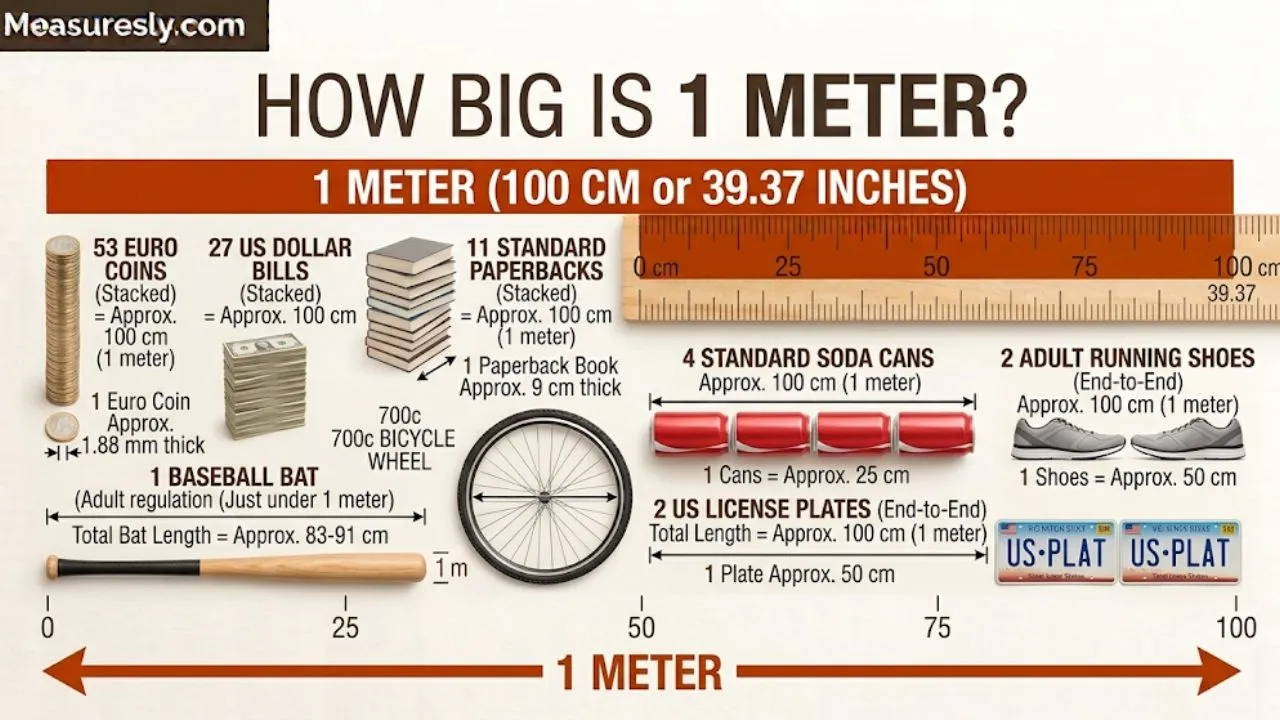

Have you ever wondered how long 1 meter actually is? Whether you are measuring furniture, checking your height, buying fabric or solving a school mathematics problem, understanding this measurement can be useful in everyday life. One meter is a standard unit of length in the metric system and is equal to 100 centimetres, 39.37 inches, or approximately 3.28 feet.
Although these numbers explain the measurement mathematically, visualising one meter can be easier when you compare it with familiar objects and human body measurements. For example, a standard meter stick is exactly one meter long, while a full-sized acoustic guitar and some baseball bats are approximately the same length.
In this guide, we will explain how long 1 meter is in feet and inches, how it compares to the human body and arms, and provide practical everyday examples to help you understand this measurement.
What Is a Meter?
A meter (symbol: m) is the standard SI unit of length used to measure the distance between two points, the height of objects and the dimensions of different spaces. It is part of the metric system, which follows a decimal-based structure and makes converting between units relatively simple.
One meter contains 100 centimetres or 1,000 millimetres. Similarly, 1,000 meters make one kilometre. The meter is commonly used in education, construction, engineering, sports, architecture and everyday measurements.
According to the National Institute of Standards and Technology (NIST), the meter is defined using the speed of light in a vacuum. It represents the distance light travels in a vacuum in 1/299,792,458 of a second. This scientific definition provides a consistent and internationally recognised measurement standard.
How Long Is 1 Meter in Feet?
One meter is equal to 3.28084 feet, which is approximately 3.28 feet. In simpler terms, it is slightly longer than three feet. Since one foot contains 12 inches, one meter can also be expressed as approximately 3 feet and 3.37 inches.
Here is a quick meter-to-feet conversion chart:
| Meters | Feet |
| 0.5 meter | 1.64 feet |
| 1 meter | 3.28 feet |
| 2 meters | 6.56 feet |
| 3 meters | 9.84 feet |
| 4 meters | 13.12 feet |
| 5 meters | 16.40 feet |
| 10 meters | 32.81 feet |
How to calculate meters into feet:
Multiply the measurement in meters by 3.28084.
For example:
5 meters × 3.28084 = 16.4042 feet.
Therefore, 5 meters is approximately 16.4 feet.
How Long Is 1 Meter in Inches?
One meter is equal to 39.3701 inches, commonly rounded to 39.37 inches.
An inch is a smaller unit of length used in the imperial and US customary measurement systems. Since one foot contains 12 inches, converting meters into inches involves multiplying the meter measurement by 39.3701.
The following chart explains the conversion:
| Meters | Inches |
| 0.25 meter | 9.84 inches |
| 0.5 meter | 19.69 inches |
| 1 meter | 39.37 inches |
| 1.5 meters | 59.06 inches |
| 2 meters | 78.74 inches |
| 3 meters | 118.11 inches |
| 5 meters | 196.85 inches |
How to calculate meters into inches:
Multiply the number of meters by 39.3701.
For example:
2 meters × 39.3701 = 78.7402 inches.
Therefore, 2 meters is approximately 78.74 inches long.
Quick Conversion Chart: How Long Is 1 Meter?
If you want to understand one meter in different measurement units without performing calculations, refer to this table:
| Measurement Unit | Equivalent |
| Millimetres | 1,000 mm |
| Centimetres | 100 cm |
| Inches | 39.37 inches |
| Feet | 3.28084 feet |
| Yards | 1.09361 yards |
| Kilometres | 0.001 km |
| Miles | 0.000621 miles |
How Long Is 1 Meter? 10 Everyday Examples
One of the easiest ways to understand how long 1 meter is involves comparing it with everyday objects. You may already have several things around your home that are close to this measurement.
Here are 10 examples to help you visualise one meter:
| Everyday Object | Approximate Length |
| Meter stick | Exactly 1 meter |
| Full-sized acoustic guitar | Around 1 meter |
| Baseball bat | Around 1 meter |
| Large adult step or pace | Can be close to 1 meter |
| Small coffee table width | Depends on the design |
| Garden bench | Some models are around 1 meter long |
| Kitchen counter section | Can be around 1 meter wide |
| Golf club | Some models are close to or slightly longer than 1 meter |
| One-meter fabric strip | Exactly 1 meter |
| 40-inch measuring reference | Approximately 1.016 meters |
These are visual references rather than universal dimensions. For instance, guitar lengths depend on their body and neck designs, while baseball bats and furniture are available in different sizes.
A meter stick remains the most reliable example because it is manufactured to represent exactly 100 centimetres.
How Long Is 1 Meter in the Human Body?
The human body can provide a useful reference for understanding one meter without using a measuring instrument. Historically, people used body parts such as feet, hands, fingers and arms to estimate distances.
Here are some ways to visualise one meter using human body measurements:
1. Height of a young child: A child around five years old may be approximately one meter tall, although height varies considerably with age and development.
2. Adult waist height: For some adults, one meter is around waist level when measured vertically from the floor. However, this depends on the person’s overall height and body proportions.
3. Forearm measurement: The distance from the elbow to the tip of the middle finger is generally around 40–50 centimetres in adults. Two forearm lengths placed end to end can therefore provide a rough comparison with one meter.
4. Human walking pace: A complete walking pace, consisting of one left step and one right step, can be approximately one meter. Actual walking distances vary depending on stride length.
These comparisons make it easier to estimate measurements visually, but they should not be treated as exact standards.
How Long Is 1 Meter in Arms?
If you want to measure one meter using your arms, you can start by extending one arm sideways from your shoulder to your fingertips.
For many adults, this distance is approximately 65–80 centimetres, depending on their height and arm proportions. Therefore, one extended arm is generally shorter than one meter.
Another useful comparison is the distance between your fingertips when both arms are stretched sideways. This is known as your arm span or wingspan. For many adults, the arm span is approximately equal to their height, so it is generally longer than one meter.
You can also use the traditional cubit measurement as a reference. A cubit is the distance from the elbow to the tip of the middle finger. It was used in ancient civilisations, including Egypt, to measure lengths and construct buildings. Two cubits placed together provide a rough visual comparison with one meter.
However, arm lengths and body proportions differ between individuals. Therefore, these methods are useful for estimating a distance rather than measuring it accurately.
How to Measure 1 Meter Without a Measuring Tape?
You do not always need a measuring tape to estimate one meter. Several simple methods can help you understand this length using familiar objects and measurements.
- Use a meter stick: A standard meter stick measures exactly 100 centimetres and provides the most straightforward reference.
- Use a three-foot measurement: Measure three feet and add approximately 3.37 inches to reach one meter.
- Use a 40-inch reference: Forty inches is approximately 1.016 meters, making it a close visual comparison.
- Use a walking pace: A complete walking pace may be close to one meter, depending on your stride.
- Use your arm span: Measure the distance between your fingertips with both arms stretched sideways and use a fraction of that distance to estimate one meter.
For construction, tailoring and other tasks requiring accuracy, always use a properly marked measuring tape or meter stick.
Conclusion
One meter is equal to 100 centimetres, 39.37 inches or approximately 3.28 feet. You can visualise this measurement using a meter stick, a full-sized guitar, a baseball bat or certain household objects. Human body measurements and arm lengths can also provide useful estimates, although they vary between individuals. Understanding these comparisons makes it easier to recognise and measure one meter in everyday situations.
Frequently Asked Questions
1. How long is exactly 1 meter?
One meter is exactly 100 centimetres or 1,000 millimetres. It is equivalent to approximately 39.37 inches or 3.28084 feet.
2. How long is 1 meter in feet and inches?
One meter is approximately 3 feet and 3.37 inches, or 3.28084 feet in decimal form.
3. Is 1 meter longer than 3 feet?
Yes. One meter is 3.28084 feet, making it approximately 3.37 inches longer than three feet.
4. How can I visualise 1 meter using my arms?
You can extend one arm sideways from your shoulder to your fingertips. Since this is generally shorter than one meter, you can use it as a rough reference and estimate the additional distance needed.
5. What common objects are approximately 1 meter long?
A full-sized acoustic guitar, some baseball bats, certain golf clubs, and some small furniture pieces can be approximately one meter long. Their actual measurements depend on their design.
6. How many centimetres are in half a meter?
Half a meter is equal to 50 centimetres or 500 millimetres.