

How long is 4 foot?
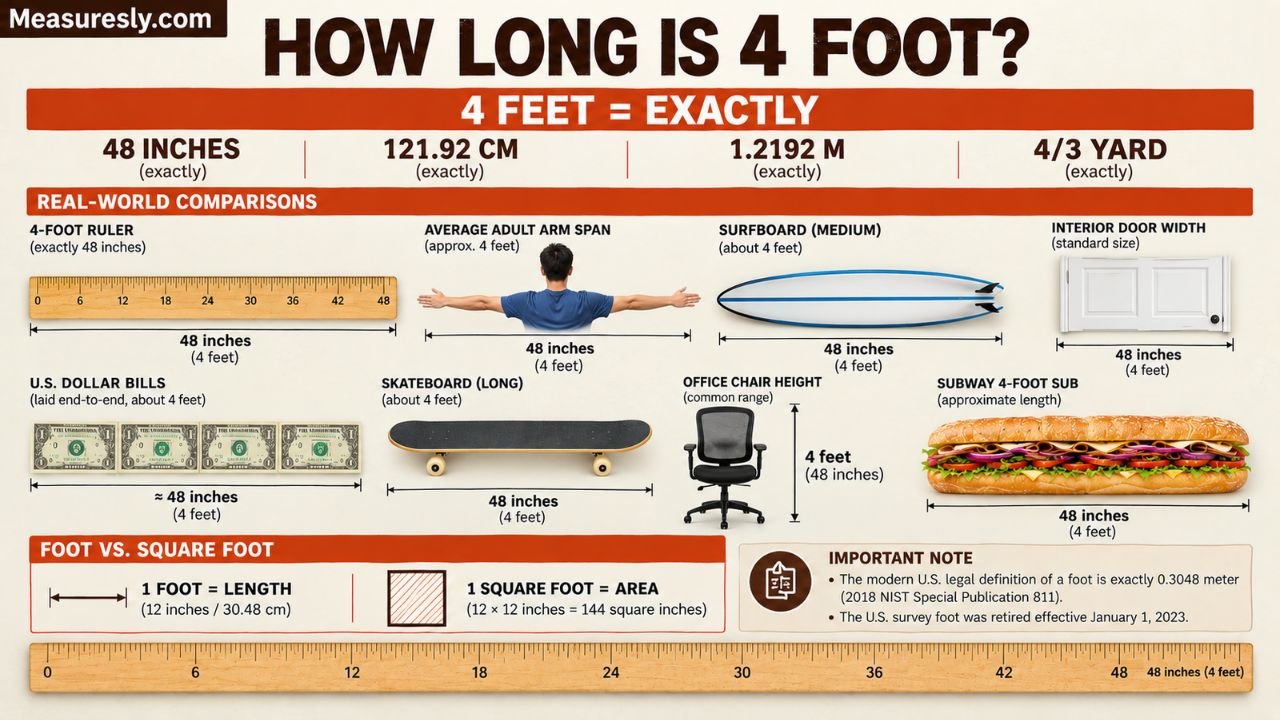
If you need the answer quickly, four feet is a length of 48 inches. In metric measurements, that same distance is 121.92 centimeters or 1.2192 meters.
But a number by itself does not always help you understand size.
Someone shopping for a shelf may want to know whether four feet will fit against a wall. A person working on a DIY project may need to convert a four-foot measurement into inches before cutting material. Someone comparing food products may encounter references to Fruit by the Foot or Subway’s large sandwich formats. Meanwhile, terms such as linear feet and square feet can create an entirely different kind of confusion.
That is why this guide looks beyond the basic conversion.
You will learn what four feet represents, how to visualize it, how it compares with nearby measurements, how 5 linear feet differs from 5 square feet, and how the popular Fruit by the Foot and Subway comparisons should be interpreted.
The objective is simple: after reading this guide, you should be able to recognize four feet whether the measurement appears in feet, inches, centimeters, meters, or a real-world product description.
The Exact Meaning of 4 Feet
A foot is a unit of length. In the modern international measurement system, one foot is defined as exactly 0.3048 meter.
That gives us the following calculation:
4 × 0.3048 = 1.2192 meters
The inch conversion uses an even simpler relationship:
1 foot = 12 inches
So:
4 × 12 = 48 inches
Four feet is also longer than one yard because a yard contains three feet.
Therefore:
4 feet = 1 yard + 1 foot
This is useful because many people can visualize a yardstick more easily than an abstract number.
Four-foot conversion chart
| Unit | Value |
| Feet | 4 ft |
| Inches | 48 in |
| Centimeters | 121.92 cm |
| Millimeters | 1,219.2 mm |
| Meters | 1.2192 m |
| Yards | 1⅓ yd |
| Kilometers | 0.0012192 km |
[Reference Source: NIST / National Institute of Standards and Technology]
The international foot definition makes these conversions fixed rather than approximate.
How Long Is 4 Feet in Inches?
The answer is 48 inches.
The calculation is:
4 feet × 12 inches = 48 inches
This is probably the most useful conversion for everyday situations because many household products are measured in inches.
For example, suppose a cabinet is advertised as four feet wide.
Instead of visualizing four feet, convert the specification to:
48 inches wide
Now imagine that the space where the cabinet will go measures 51 inches.
You have:
51 − 48 = 3 inches
of nominal extra width.
That does not necessarily mean the cabinet will fit perfectly because hinges, handles, wall irregularities, trim, and installation clearance can affect the final fit. However, converting everything into the same unit gives you a much clearer starting point.
A useful feet-to-inches pattern
| Feet | Inches |
| 1 | 12 |
| 2 | 24 |
| 3 | 36 |
| 4 | 48 |
| 5 | 60 |
| 6 | 72 |
[Reference Source: NIST]
If you remember only one rule, remember this:
Multiply feet by 12 to get inches.
How Long Is 4 Feet in Centimeters?
Four feet is 121.92 centimeters.
The conversion is based on the fact that one foot equals 30.48 centimeters:
4 × 30.48 = 121.92 cm
For everyday conversation, you may hear someone round this to approximately 122 cm.
There is nothing wrong with rounding when you are estimating. However, if the measurement is being used for manufacturing, construction, furniture fitting, or another precision task, keeping the full conversion is better.
Exact versus approximate
Exact conversion:
4 feet = 121.92 cm
Rounded conversion:
4 feet ≈ 122 cm
The difference is only 0.08 cm, but whether that difference matters depends on what you are measuring.
For example, a rough room-layout discussion can use 122 cm. A technical drawing may require the exact value.
[Reference Source: NIST]
How Long Is 4 Feet in Meters?
Four feet equals 1.2192 meters.
That means a four-foot object is a little more than 1.2 meters long.
To see the difference:
1.2192 − 1.2 = 0.0192 meter
That is 1.92 centimeters.
So if someone asks for a quick mental comparison, you can think:
Four feet is approximately 1.22 meters.
For exact conversion:
Four feet = 1.2192 meters.
This distinction between an exact value and a rounded value is worth keeping in mind when writing product specifications or comparing international measurements.
[Reference Source: NIST]
What Does 4 Feet Look Like?
This is often the real reason people search for the measurement.
Knowing that four feet equals 48 inches is useful, but the question “What does 48 inches actually look like?” is easier to answer with physical references.
Imagine Four 12-Inch Rulers
This is one of the simplest demonstrations.
Take four standard rulers, each measuring 12 inches.
Put them end to end:
12 + 12 + 12 + 12 = 48 inches
That produces exactly four feet.
This method is particularly useful if you are explaining the measurement to a child or checking the approximate size of something at home.
Think of a Yardstick Plus One Foot
A yardstick represents one yard.
Since:
1 yard = 3 feet
adding another foot gives you:
3 + 1 = 4 feet
So four feet can be visualized as a complete yardstick followed by another 12-inch section.
Compare It With One Meter
A meter is shorter than four feet.
Four feet reaches:
121.92 cm
A one-meter length reaches:
100 cm
The difference is:
21.92 cm
So a four-foot object is about 22 centimeters longer than a meter.
That makes four feet noticeably longer than a one-meter ruler or measuring stick.
Everyday Objects That Can Help You Picture 4 Feet
Many websites use everyday objects to explain measurements, but there is an important caveat: objects manufactured for consumers are rarely exact measurement standards.
For visualization, however, they can still be useful.
A four-foot distance can be similar to the length or width of some:
- Small folding tables
- Narrow workbenches
- Garden benches
- Shelves
- Storage units
- TV stands
- Short sections of countertop
- Some sports equipment
- Certain household tools
Current search results also commonly use folding tables, pool cues, step ladders and sports equipment as visual references for four feet.
These examples should be treated as approximate comparisons, not proof that every item of that type measures exactly four feet.
For a product that must fit into a particular space, use the manufacturer’s stated dimensions or measure the item yourself.
4 Feet vs. 1 Yard vs. 1 Meter
Three measurements are easy to confuse because they are relatively close.
| Measurement | Exact Length |
| 1 yard | 3 feet |
| 4 feet | 4 feet |
| 1 meter | 3.28084 feet |
This means:
1 yard = 36 inches
4 feet = 48 inches
1 meter = approximately 39.37 inches
So four feet is longer than both one yard and one meter.
The easiest relationship to remember is:
3 feet = 1 yard
and:
4 feet = 1⅓ yards
[Reference Source: NIST]
What Is 4 Linear Feet?
The expression “4 linear feet” means four feet measured along one straight dimension.
In other words:
4 linear feet = 4 feet of length
or:
48 linear inches
The word linear becomes useful when material is sold according to its length.
You might encounter this term when purchasing:
- Countertops
- Trim
- Molding
- Wire
- Cable
- Fabric
- Shelving
- Certain construction materials
Example
Suppose a store sells countertop material by the linear foot.
You purchase four linear feet.
You have purchased:
48 inches of length
But you still need to know the countertop’s width before calculating its total surface area.
If the countertop is 2 feet wide:
4 × 2 = 8 square feet
If it is 1.5 feet wide:
4 × 1.5 = 6 square feet
The linear measurement stayed at four feet. The area changed because the width changed.
This is one of the most important distinctions to understand when buying material.
How Long Is 5 Linear Foot?
The secondary search “how long is 5 linear foot” is really asking about 5 linear feet.
Five linear feet equals:
5 feet
which converts to:
60 inches
152.4 centimeters
1.524 meters
Comparing four and five linear feet
| Measurement | Inches | Centimeters |
| 4 linear feet | 48 | 121.92 |
| 5 linear feet | 60 | 152.4 |
| Difference | 12 | 30.48 |
So moving from four linear feet to five linear feet adds exactly one additional foot.
That is useful when estimating how much trim, cable, fabric, shelving, or another long material you need.
What Does 5 Square Feet Mean?
The phrase “how long is 5 square foot” needs a little clarification.
Five square feet is an area, not a straight-line length.
That means you cannot convert five square feet into one single length without knowing another dimension.
For example:
5 feet × 1 foot = 5 square feet
But:
2.5 feet × 2 feet = 5 square feet
Both rectangles contain the same area even though their dimensions are different.
This is why square footage is commonly used for:
- Flooring
- Carpet
- Wall coverage
- Countertops
- Tile
- Room areas
- Land or garden plots
Five square feet in square inches
One square foot contains:
12 × 12 = 144 square inches
Therefore:
5 × 144 = 720 square inches
So:
5 square feet = 720 square inches
[Reference Source: NIST conversion factors]
Five square feet in square meters
Five square feet is approximately:
0.4645 square meter
This is just under half a square meter.
The exact dimensions of the area could vary considerably, which is why “five square feet long” is not technically a complete description.
How Long Is 3 Fruit by the Foot?
The phrase “how long is 3 Fruit by the Foot” refers to the packaged snack rather than three feet as a measurement.
Fruit by the Foot is marketed as a long rolled fruit-flavored snack. Product descriptions have traditionally positioned an individual strip at approximately three feet.
[Reference Source: General Mills / Fruit by the Foot]
If one roll is treated as approximately three feet, then:
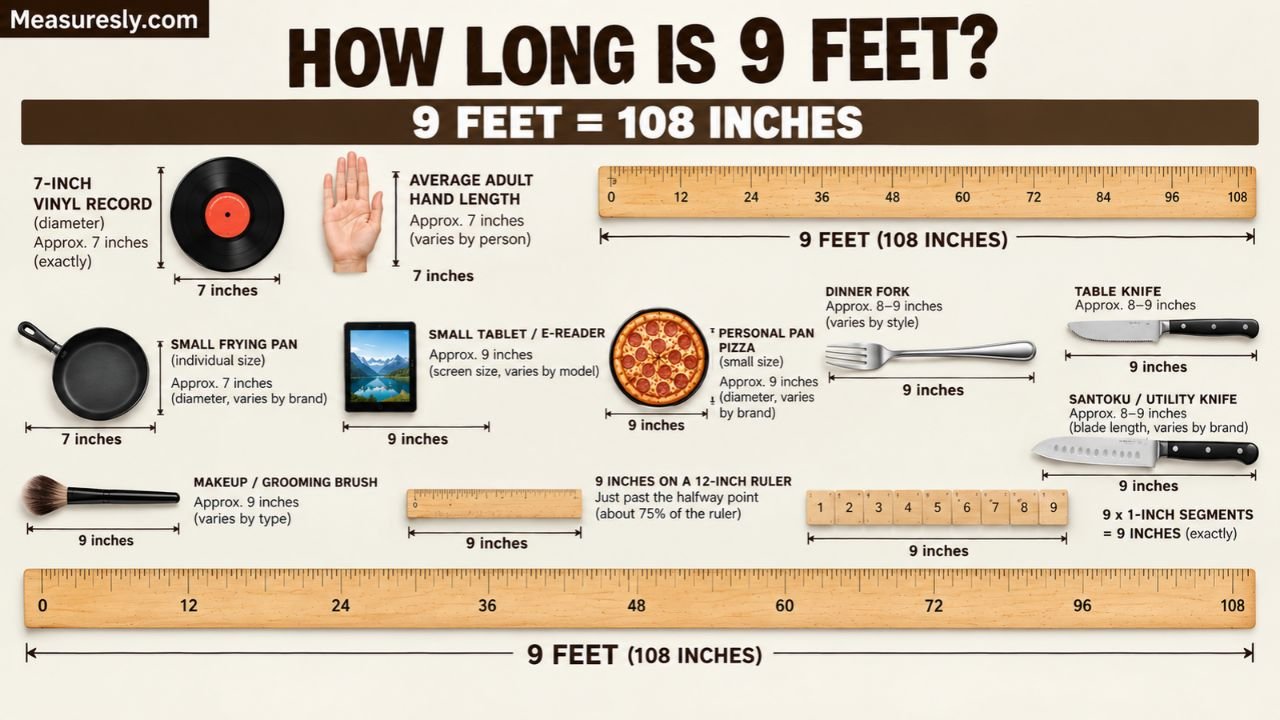
3 rolls × 3 feet = approximately 9 feet
That gives:
9 feet = 108 inches
and:
9 feet = 274.32 centimeters
So three rolls placed end to end would represent approximately nine feet of snack.
Why “approximately” matters
A packaged food product should not be treated like a precision measuring device.
The physical result can depend on:
- How the roll is unfolded
- Whether the folded end is included
- How the strip is handled
- Product variation
- Measurement method
Therefore, the best editorial approach is to use the advertised or commonly stated product length as a visual comparison, rather than presenting it as a laboratory-standard 36-inch object.
How Much Is 5 Foot Long at Subway?
The wording “how much is 5 foot long at Subway” can refer to either length or price, and those questions need different answers.
If you mean five feet in length
Five feet is:
60 inches
152.4 centimeters
1.524 meters
So a hypothetical sandwich measuring five feet from end to end would be 60 inches long.
However, that does not mean Subway currently sells a standard five-foot sandwich.
Does Subway have a 5-foot Giant Sub?
Current Subway catering information lists 3-foot and 6-foot Giant Sub options rather than a standard five-foot Giant Sub. Subway also notes that its Giant Sub measurements are approximate.
This distinction is important.
A mathematical measurement of five feet does not automatically mean there is a corresponding menu item.
What if you mean price?
There is no universal price that can accurately be stated for a hypothetical five-foot Subway sandwich.
Subway prices can vary according to:
- Restaurant location
- Country
- Menu
- Catering availability
- Ingredients
- Promotions
- Ordering channel
Therefore, a current price should be checked against the specific restaurant rather than inserted as a generic number.
A 4-Foot Measurement in a Real Home Project
Consider a person buying a wall shelf.
The product listing says:
Length: 4 feet
The room measurement is:
Width available: 50 inches
First convert the shelf:
4 feet = 48 inches
Then compare:
50 − 48 = 2 inches
At first glance, the shelf appears to fit.
But this does not automatically mean installation will work.
The buyer should also check:
- Actual shelf dimensions
- Bracket position
- Wall trim
- Door clearance
- Side gaps
- Mounting hardware
- Whether the listed measurement includes decorative edges
This example shows why conversion is only the first step in a real-world measurement problem.
Another Example: Buying Material by Linear Feet
Suppose you need material for a DIY project.
The supplier sells it by linear foot.
You estimate that you need 5 linear feet.
That means:
5 × 12 = 60 inches
But if the project actually requires 4 feet 8 inches, you could calculate the difference:
60 − 56 = 4 inches
This illustrates why converting everything to inches can make small differences easier to spot.
For materials that are cut to size, always allow for the manufacturer’s actual dimensions and any cutting waste.
Four Feet as a Height Measurement
“Four feet” does not have to describe horizontal length.
It can also describe height.
For example:
- A four-foot fence
- A four-foot cabinet
- A four-foot sign
- A four-foot barrier
- A four-foot plant
- A four-foot storage unit
In these cases, the measurement represents the vertical distance from the chosen starting point to the top.
The same conversion applies:
4 feet = 48 inches = 121.92 cm
The orientation changes, but the length unit does not.
Read More: How Long Is 11 Inches? Complete Size Guide With Real-Life Comparisons
Why Measuring Tools Are Better Than Visual Guessing
Visual comparisons are useful for understanding size, but they are not reliable enough for precision work.
An object can look four feet long while actually measuring:
- 46 inches
- 47.5 inches
- 48 inches
- 49 inches
- 50 inches
The difference may be difficult to see with the naked eye.
If the measurement determines whether something will fit, be cut correctly, or align with another component, use a tape measure or another suitable measuring instrument.
A simple measuring process
1. Find the true starting point.
Place the zero mark at the edge you are measuring from.
2. Keep the tape straight.
A diagonal measurement can produce a larger reading.
3. Find 48 inches.
That is the four-foot point.
4. Record the actual result.
If the object stops at 47 inches, it is not exactly four feet.
This small habit can prevent expensive mistakes when working with materials.
Common Mistakes With 4-Foot Measurements
Mistake 1: Assuming a foot has 10 inches
It does not.
1 foot = 12 inches.
Therefore:
4 feet = 48 inches.
[Reference Source: NIST]
Mistake 2: Confusing feet and square feet
A foot describes length.
A square foot describes area.
They should never be substituted for one another.
Mistake 3: Treating 1.22 meters as the exact value
Four feet is 1.2192 meters.
1.22 meters is the rounded version.
Mistake 4: Assuming product comparisons are exact
A folding table or household object described as “about four feet” may not actually measure 48 inches.
Mistake 5: Ignoring the second dimension
When buying a material by linear foot, the width can dramatically change the amount of surface area covered.
Four Feet: A Quick Comparison With Nearby Measurements
Seeing adjacent measurements can make the scale easier to understand.
| Measurement | Inches | Centimeters |
| 2 feet | 24 | 60.96 |
| 3 feet | 36 | 91.44 |
| 4 feet | 48 | 121.92 |
| 5 feet | 60 | 152.4 |
| 6 feet | 72 | 182.88 |
The jump from one foot to the next is always:
12 inches
or:
30.48 centimeters
That makes it easy to estimate neighboring lengths.
Frequently Asked Questions
Four feet is exactly 48 inches, 121.92 centimeters, and 1.2192 meters.
Yes. Four feet equals 1.2192 meters, so it is 21.92 cm longer than one meter.
There are 48 inches in four feet.
There are 121.92 centimeters in four feet.
Four feet equals 1.2192 meters.
Four feet equals 1⅓ yards.
Four linear feet is a straight-line length of four feet, or 48 inches.
Five linear feet equals 60 inches, 152.4 cm, or 1.524 meters.
Five square feet describes an area. It equals 720 square inches, but its actual shape can vary.
Using the commonly advertised approximately three-foot length per roll, three rolls would total roughly 9 feet when laid end to end.
Current official catering information lists 3-foot and 6-foot Giant Subs, rather than a standard five-foot option. Availability can depend on the location.
There is no universal price for a standard five-foot Subway sandwich because that size is not listed as a standard current Giant Sub format. Local catering menus and promotions determine actual prices.
Think of four 12-inch rulers, 48 inches, or a little more than 1.2 meters.
Final Takeaway
If you need the answer in one line:
4 feet is 48 inches, 121.92 centimeters, or 1.2192 meters.
A useful mental picture is a distance slightly longer than one meter or four standard 12-inch rulers placed end to end.
When dealing with the related measurements, keep the categories separate. Linear feet measure length, while square feet measure area. Five linear feet is therefore a 60-inch distance, whereas five square feet represents a surface area of 720 square inches.
Product comparisons such as Fruit by the Foot and Subway’s Giant Subs can make measurements easier to visualize, but product dimensions and menu availability should always be checked separately from mathematical conversions.
For a rough estimate, visual references are useful. For cutting, construction, furniture fitting, or installation, reach for a measuring tape.
The key number to remember is simple: 4 feet = 48 inches.
[Reference Source: NIST / National Institute of Standards and Technology]
Read More: How Long Is 12 Inches? Exact Measurement, Conversions & Real-Life Comparisons
Aarav Choudhary
I’m Aarav Choudhary, a content researcher and technical writer with a strong interest in online calculators, unit conversion tools, and educational resources. At Measuresly, I focus on simplifying complex calculations into practical, reader-friendly content. Every article I write is thoroughly researched, fact-checked, and regularly updated to ensure accuracy and reliability.