

Last Updated: 2026
Wondering how long is 1 foot?
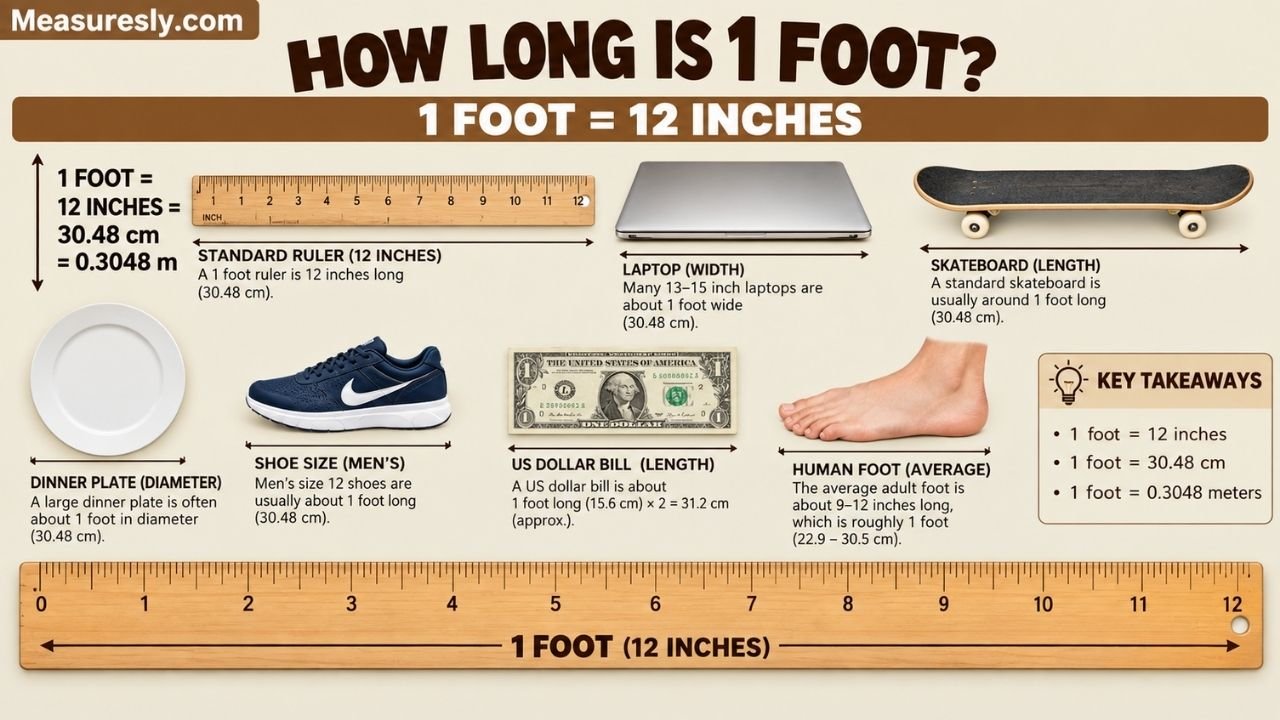
One foot is 12 inches, which equals 30.48 centimeters, 304.8 millimeters, or 0.3048 meter. The international foot has an exact metric definition of 0.3048 meter.
So, in simple terms:
1 foot = 12 inches = 30.48 cm = 304.8 mm = 0.3048 m
A foot is a measurement of length, while a square foot describes an area. A linear foot also measures length, so one linear foot is the same physical distance as one foot.
Interestingly, searches for “1 foot” often lead to questions involving everyday products such as Fruit by the Foot or Subway’s Footlong. Those examples can make the measurement easier to visualize, but they shouldn’t be confused with formal measurement standards.
How Long Is 1 Foot?
Measurements are easy when you have a ruler in front of you. But when someone says an object is “one foot long,” it can be surprisingly difficult to picture its actual size.
Is it closer to 20 centimeters or 40 centimeters? How many inches are there? What does one foot look like without a measuring tape? And why does square foot mean something completely different from a regular foot?
The answer begins with one simple relationship:
One foot contains 12 inches.
According to the National Institute of Standards and Technology (NIST), the international foot is defined as exactly 0.3048 meter.
That gives us a reliable starting point for everything else.
In this guide, we’ll break down one foot from several angles—including metric conversions, everyday visualization, linear feet, square feet, Fruit by the Foot, and the Subway Footlong—so you can understand the measurement rather than simply memorize a conversion.
1 Foot Explained: The Basic Measurement
The word foot refers to a unit used to describe distance or length.
Its abbreviation is:
ft
The plural is:
feet
For example:
1 ft = 1 foot
2 ft = 2 feet
10 ft = 10 feet
The modern international definition is precise:
1 ft = 0.3048 m
NIST explains that the international foot was established through the 1959 refinement of the relationship between the yard and meter. The foot is therefore no longer dependent on the size of a person’s actual foot.
The Most Important Relationship
The easiest conversion to remember is:
1 foot = 12 inches
From there, other conversions can be calculated.
Because an inch is exactly 2.54 centimeters:
12 × 2.54 = 30.48 centimeters
Therefore:
1 foot = 30.48 cm
NIST’s conversion tables likewise list 12 inches or 1 foot as 30.48 centimeters and 304.8 millimeters.
1 Foot Conversion Chart
Here’s a quick reference for the most common units:
Unit Equivalent to 1 Foot
Inches 12
Centimeters 30.48
Millimeters 304.8
Meters 0.3048
Yards 0.3333…
Feet 1
For everyday calculations, the two conversions you’ll probably use most often are:
Feet → inches: multiply by 12
Feet → centimeters: multiply by 30.48
Example
If a table is 4 feet long:
4 × 12 = 48 inches
And:
4 × 30.48 = 121.92 cm
NIST’s published conversion tables use the same 0.3048-meter relationship.
What Does 1 Foot Look Like?
Knowing the number isn’t always enough. Sometimes you need a visual reference.
Here are several practical ways to imagine one foot.
A 12-Inch Ruler
The most direct comparison is a standard ruler marked from 0 to 12 inches.
The distance represented by those 12 inches is exactly one foot.
If you have a ruler available, this is preferable to guessing from an everyday object because the ruler is specifically designed for measurement.
One-Third of a Yardstick
A yard contains three feet.
Therefore:
1 yard = 3 feet
and:
1 foot = ⅓ yard
A yardstick is typically three feet long, so dividing that length into three equal sections gives approximately one foot per section.
NIST’s measurement references establish the relationship between yards and feet through the standardized definition of the yard and foot.
A 30-Centimeter Approximation
If you’re more comfortable with metric measurements, think of one foot as a little more than 30 centimeters.
The exact value is:
30.48 cm
So saying “about 30 cm” is useful for rough visualization, but it isn’t appropriate when precision is required.
For example:
Approximate: 30 cm
Exact: 30.48 cm
That 0.48-cm difference may be irrelevant for estimating the size of a household object but could matter in a precise construction or manufacturing task.
How Long Is 1 Linear Foot?
The phrase linear foot can sound like it describes a different measurement from a normal foot.
It doesn’t.
1 Linear Foot = 12 Inches
A linear foot simply emphasizes that you’re measuring one-dimensional length.
For example, imagine a piece of molding running along a wall.
If the molding is 8 feet from one end to the other, it contains:
8 linear feet
Its width doesn’t change that measurement.
Why Use the Word “Linear”?
The word becomes useful when you’re purchasing materials that are sold by length.
Common examples include:
Trim
Molding
Baseboards
Some types of lumber
Fencing
Wire
Cable
Piping
Imagine you need 18 feet of decorative trim.
You could describe your requirement as:
18 linear feet of trim
You are measuring the length of the material, not its surface area.
Linear Foot vs. Square Foot
This distinction is extremely important.
Consider a wooden board.
If you ask:
“How long is it?”
you might answer:
6 feet
If you’re calculating how much surface it covers, you need additional dimensions.
For example, suppose the board is:
6 feet long
1 foot wide
Its surface area is:
6 × 1 = 6 square feet
So:
6 linear feet ≠ 6 square feet
The first describes length; the second describes area.
How Long Is 1 Square Foot?
Here’s where the wording gets tricky.
A square foot isn’t a length measurement.
It’s an area measurement.
One square foot represents an area that can be formed by a square measuring:
1 foot × 1 foot
Since eachside is 12 inches:
12 inches × 12 inches = 144 square inches
Therefore:
1 square foot = 144 square inches
This is a fundamentally different concept from one foot.
Visualizing One Square Foot
Imagine placing a ruler horizontally and measuring 12 inches.
Now imagine another 12-inch measurement running perpendicular to it.
The enclosed square has an area of one square foot.
It doesn’t matter that another rectangle could also contain 144 square inches.
For example:
6 × 24 inches = 144 square inches
That rectangle has the same area as one square foot, even though it isn’t shaped like a one-foot-by-one-foot square.
This is why area calculations require multiplying two dimensions.
Foot vs. Linear Foot vs. Square Foot
Here’s the easiest way to separate the three:
Term What It Measures Basic Example
Foot Length 12 inches
Linear foot Length 12 inches of material
Square foot Area 12 × 12 inches
You can remember it like this:
Foot = distance
Linear foot = distance along a material
Square foot = surface area
How Much Is 1 Foot Long at Subway?
The phrase “how much is 1 foot long at Subway” usually refers to the restaurant chain’s Footlong sandwich.
The name itself gives you the intended measurement comparison:
Footlong = 1 foot long
That means the intended size corresponds to:
12 inches
Subway’s menu and ordering systems use Footlong and 6-inch as sandwich size categories.
For a quick mental comparison:
6-inch sandwich → ½ foot
12-inch Footlong → 1 foot
However, it’s important not to treat a restaurant product as a calibrated measuring device. Food products can have small physical variations caused by shaping, baking and preparation.
If you’re measuring a table, shelf, wall or piece of wood, use an actual measuring tool.
How Long Is 1 Fruit by the Foot?
The phrase “how long is 1 Fruit by the Foot” is slightly different because the product’s name isn’t describing a one-foot measurement.
Fruit by the Foot is a rolled fruit-flavored snack traditionally associated with a strip measuring about three feet in length.
That gives us:
3 feet = 36 inches
and:
36 inches × 2.54 = 91.44 cm
So, as a rough product comparison:
1 Fruit by the Foot ≈ 3 feet ≈ 91.44 cm
The exact physical length of a packaged food item can depend on the product version and how the strip is measured, so this should be treated as a product comparison rather than a measurement standard.
The important takeaway is that Fruit by the Foot is not one foot long simply because “foot” appears in the name.
How to Measure One Foot Correctly
If you need an accurate one-foot measurement, estimating from an object isn’t the best method.
Use the following process.
Step 1: Find the Starting Point
Put the beginning of your ruler or tape measure exactly at the point where your measurement starts.
Step 2: Keep the Measuring Tool Straight
For a straight object, the tape should follow the same direction as the object’s length.
A slight angle can make the measured distance incorrect.
Step 3: Find 12 Inches
Locate the:
12-inch mark
That point represents one foot.
Step 4: Mark the Endpoint
If you’re cutting material, use a pencil or suitable marking tool to identify the 12-inch point.
Step 5: Double-Check
For important measurements, measure again before cutting or installing anything.
This simple habit can prevent expensive material mistakes.
Read More: How Long Is 11 Inches? Complete Size Guide With Real-Life Comparisons
How to Calculate Feet From Inches
If you’re given a measurement in inches and need feet, divide by 12.
Formula
Feet = Inches ÷ 12
Example
Suppose a board measures 48 inches.
48 ÷ 12 = 4 feet
So:
48 inches = 4 feet
Another example:
30 inches ÷ 12 = 2.5 feet
Therefore:
30 inches = 2.5 feet
How to Calculate Inches From Feet
If you know the number of feet and need inches, multiply by 12.
Formula
Inches = Feet × 12
For example:
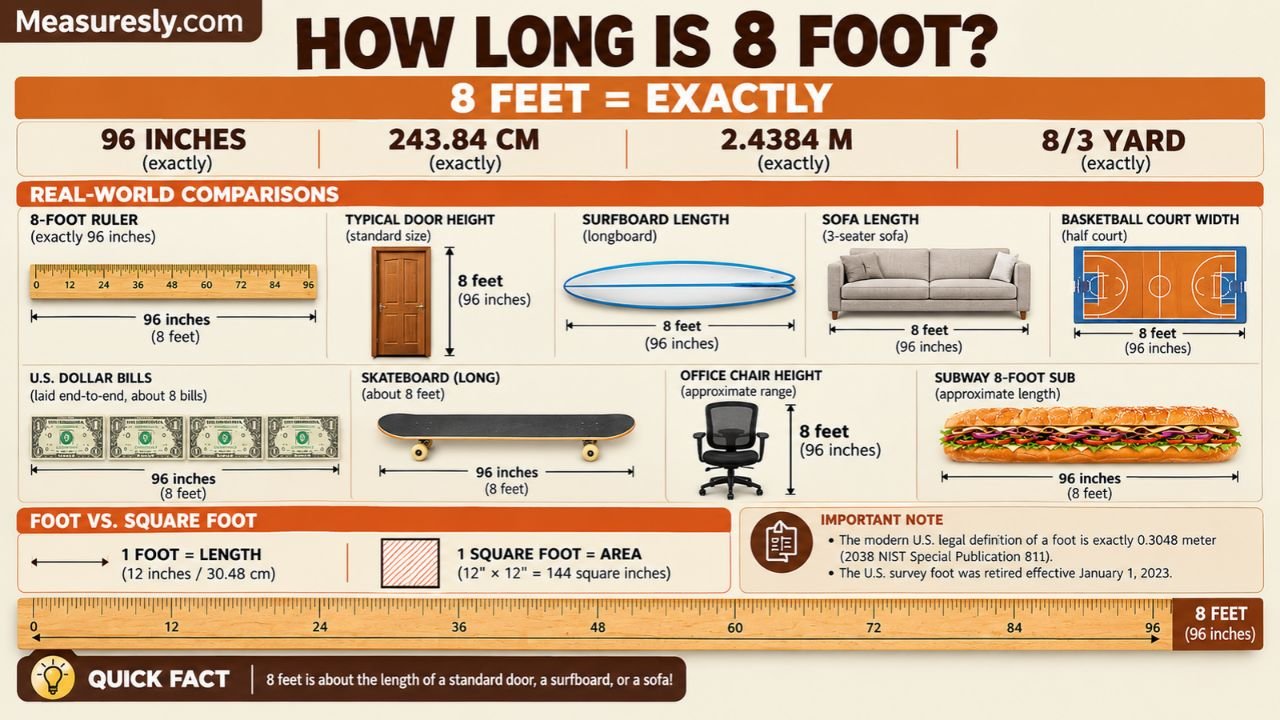
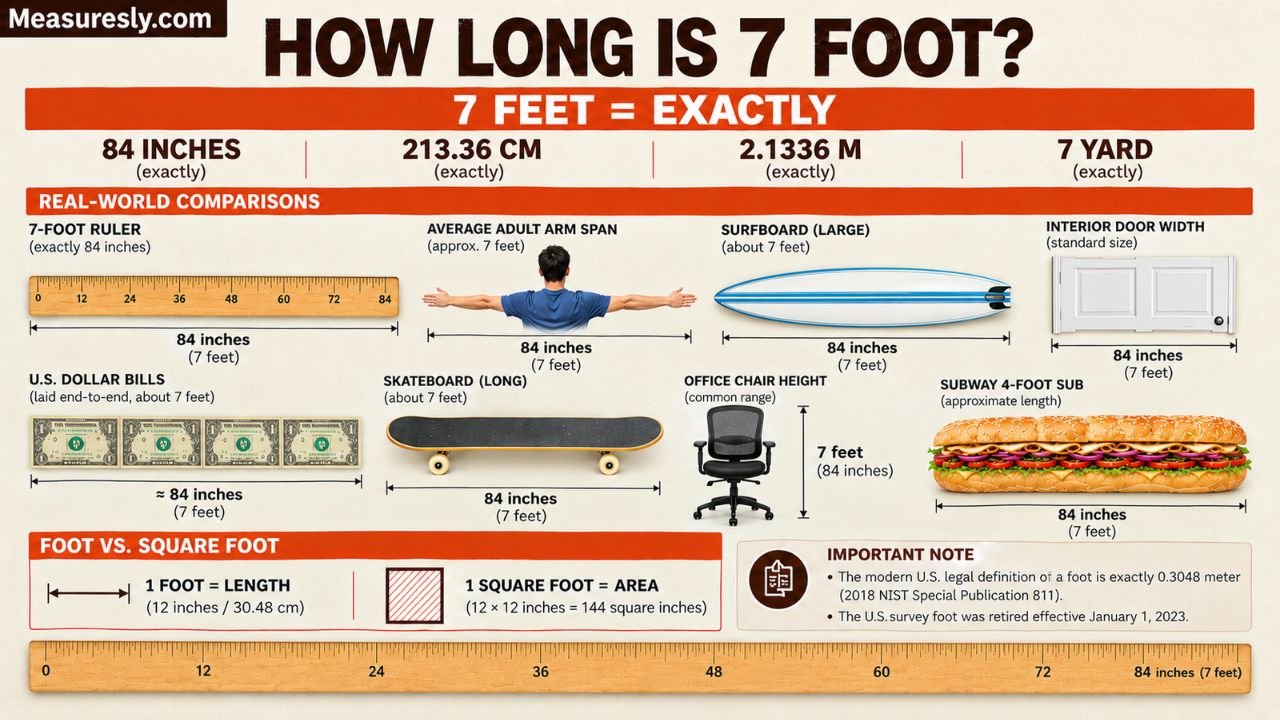
7 feet × 12 = 84 inches
Therefore:
7 feet = 84 inches
This is particularly useful when product dimensions are listed in feet but you’re comparing them with an object measured using an inch-based ruler.
How to Convert Feet to Centimeters
For metric conversion:
Formula
Centimeters = Feet × 30.48
Example:
5 × 30.48 = 152.4 cm
Therefore:
5 feet = 152.4 cm
For one foot:
1 × 30.48 = 30.48 cm
NIST provides 0.3048 meter as the exact international-foot conversion factor.
How to Convert Centimeters to Feet
To reverse the calculation:
Formula
Feet = Centimeters ÷ 30.48
Suppose something measures 60.96 cm.
60.96 ÷ 30.48 = 2 feet
So:
60.96 cm = 2 feet
This is useful when shopping internationally because many products list dimensions in centimeters while U.S. product listings commonly use inches or feet.
Real-World Examples of One Foot
Understanding measurements becomes easier when you apply them to realistic situations.
Example 1: A Shelf
A product description says:
Shelf length: 3 feet
Convert it into inches:
3 × 12 = 36 inches
So the shelf is 36 inches long.
Example 2: A Wall
A wall is 12 feet long.
Its length in inches is:
12 × 12 = 144 inches
The wall therefore measures 144 inches from one end to the other.
Example 3: Flooring
A rectangular room measures:
10 feet × 12 feet
Its floor area is:
10 × 12 = 120 square feet
Notice that you don’t say the room is “120 feet long.”
The correct statement is:
The room has 120 square feet of floor area.
Example 4: Trim
You need 15 feet of trim.
That is:
15 linear feet
If the trim is sold by the linear foot, its price can be calculated from the number of linear feet purchased.
However, always account for cutting waste when planning a real installation.
Why the Foot Is Still Commonly Used
The meter is the SI unit used for length, and NIST identifies the meter as the preferred measurement unit for length in the United States. At the same time, non-SI units such as feet and inches continue to appear in everyday commerce and product measurements.
That’s why you’ll encounter both systems.
For example, a product might be listed as:
Dimensions: 2 ft × 3 ft
while another listing may say:
Dimensions: 60.96 cm × 91.44 cm
They can describe essentially the same dimensions using different units.
Knowing how to switch between the two systems makes product specifications much easier to understand.
Common Mistakes When Working With Feet
Mistake 1: Treating a Square Foot as a Foot
A foot measures length.
A square foot measures area.
Don’t use the two terms interchangeably.
Mistake 2: Forgetting the 12-Inch Rule
The foundation is:
1 foot = 12 inches
Not 10 inches and not 100 inches.
Mistake 3: Calling an Estimate an Exact Measurement
Saying something is “roughly one foot” is different from measuring exactly 12 inches.
Use a ruler or tape measure when accuracy matters.
Mistake 4: Confusing Length With Diameter
If a circular object is described as 12 inches across, that measurement normally refers to its diameter.
It doesn’t mean the object has a 12-inch circumference.
Mistake 5: Assuming a Product Name Is a Measurement Standard
“Footlong” is a product description.
It isn’t a replacement for a calibrated ruler.
A Simple Mental Trick for Remembering One Foot
If you frequently need to estimate measurements, remember this chain:
1 foot → 12 inches → about 30.5 cm
The exact metric value is:
30.48 cm
So when you’re looking at a measurement, you can quickly classify it:
6 inches → half a foot
12 inches → one foot
18 inches → one and a half feet
24 inches → two feet
36 inches → three feet
This mental reference makes furniture dimensions, package sizes and room measurements easier to interpret.
Frequently Asked Questions
Yes. One international foot corresponds to 12 inches, and the international foot is exactly 0.3048 meter.
There are 30.48 centimeters in one foot.
Not exactly. One foot is 30.48 cm, so 30 cm is slightly shorter.
1 foot = 0.3048 meter.
Two feet contain:
2 × 12 = 24 inches
One yard contains 3 feet.
A linear foot describes one foot of length along a material or object. 1 linear foot = 12 inches.
A square foot measures area. A one-square-foot square has dimensions of 1 foot × 1 foot, equivalent to 144 square inches.
“Footlong” is Subway’s sandwich size terminology intended to represent a 12-inch format. Individual food products should not be treated as precision measuring instruments.
Fruit by the Foot has traditionally been described as approximately three feet long, or 36 inches, although actual product dimensions can vary.
Final Answer: How Long Is 1 Foot?
So, how long is 1 foot?
The exact answer is:
1 foot = 12 inches = 30.48 centimeters = 304.8 millimeters = 0.3048 meter.
For everyday visualization, think of the distance covered by a 12-inch ruler.
If you’re dealing with materials, remember that linear feet measure length, while square feet measure area. And if you’re using familiar products as references, a Subway Footlong is intended as a 12-inch sandwich size, while Fruit by the Foot is traditionally associated with a strip roughly three feet long.
The most useful fact to remember is simple:
12 inches make 1 foot.
Once you know that relationship, converting between feet, inches and centimeters becomes straightforward.
Reference authority: NIST’s current measurement guidance confirms the international foot as exactly 0.3048 meter and notes that the former U.S. survey foot was retired for general applications beginning in 2023.
Read More: How Long Is 12 Inches? Exact Measurement, Conversions & Real-Life Comparisons
Aarav Choudhary
I’m Aarav Choudhary, a content researcher and technical writer with a strong interest in online calculators, unit conversion tools, and educational resources. At Measuresly, I focus on simplifying complex calculations into practical, reader-friendly content. Every article I write is thoroughly researched, fact-checked, and regularly updated to ensure accuracy and reliability.