

Last Updated: September 2026
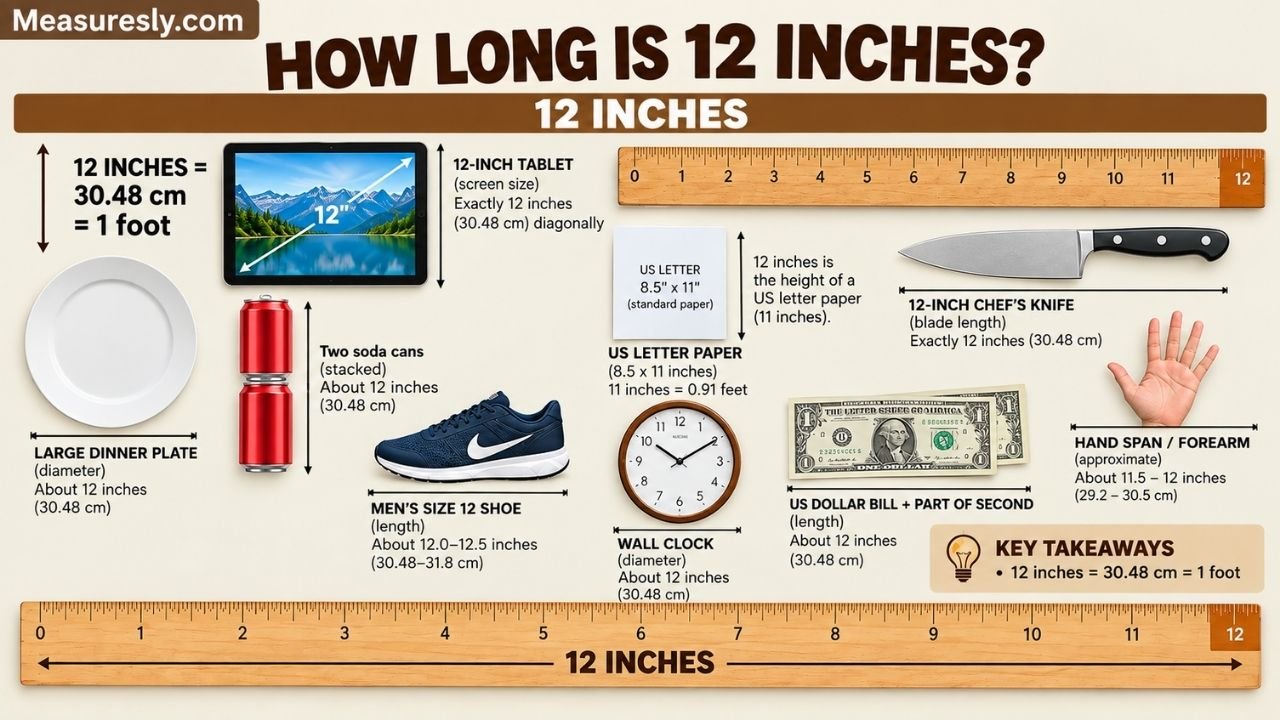
If you are wondering how long is 12 inches, the simplest answer is: 12 inches is exactly 1 foot, which equals 30.48 centimeters or 304.8 millimeters. But knowing the conversion is not always enough. Many people can understand “one foot” mathematically but still have difficulty visualizing what that distance actually looks like.
That is why comparing 12 inches with familiar objects can be useful. A 12-inch ruler provides an exact physical reference, while objects such as US Letter paper, a vinyl record, a plate, or certain household items can help create a mental picture.
This guide explains exactly how long 12 inches is, converts it into metric units, answers how long is 12 cm in inches, and explores how long is 12 inches compared to an object. It also explains an important measurement principle: an object described as “12 inches” may have a 12-inch length, width, diameter, or diagonal, so the measurement direction matters.
Quick Answer: How Long Is 12 Inches?
12 inches = 1 foot = 30.48 cm = 304.8 mm = 0.3048 meters.
The inch has an exact modern definition of 25.4 millimeters. Therefore:
12 × 25.4 mm = 304.8 mm
And:
304.8 mm = 30.48 cm
NIST’s measurement information specifies that one inch is exactly 25.4 millimeters and that one foot equals 12 inches. [Reference Source: National Institute of Standards and Technology (NIST)]
| Measurement | Equivalent to 12 inches |
| Inches | 12 in |
| Feet | 1 ft |
| Centimeters | 30.48 cm |
| Millimeters | 304.8 mm |
| Meters | 0.3048 m |
| Yards | 0.3333 yd approximately |
So, if you have a ruler marked from 0 to 12 inches, the distance from the 0-inch mark to the 12-inch mark represents exactly one foot.
Understanding the Fundamentals of 12 Inches
What Does 12 Inches Mean?
An inch is a unit of length used primarily within the U.S. customary measurement system and also encountered in many product specifications around the world.
Twelve inches make one foot:
12 inches = 1 foot
This relationship is exact, not an estimate. The modern inch is defined as exactly 25.4 millimeters, which means all conversions from inches to metric units can be calculated precisely. [Reference Source: NIST]
The easiest way to visualize the measurement is to imagine a straight line that is 12 inches long.
You can divide that line into smaller sections:
- 2 sections of 6 inches
- 3 sections of 4 inches
- 4 sections of 3 inches
- 6 sections of 2 inches
- 12 sections of 1 inch
This makes 12 inches particularly useful as a mental measurement reference.
How Long Is 12 Inches in Centimeters?
Because:
1 inch = 2.54 cm
you can calculate:
12 × 2.54 = 30.48 cm
Therefore:
12 inches = exactly 30.48 centimeters
This is slightly longer than 30 centimeters by 0.48 cm, or 4.8 millimeters.
For someone accustomed to metric measurements, thinking of 12 inches as a little over 30 centimeters is a convenient mental shortcut. However, when precision matters, use the exact value of 30.48 cm.
[Reference Source: National Institute of Standards and Technology (NIST)]
How Long Is 12 Inches Compared to an Object?
Object comparisons are one of the easiest ways to understand a measurement without doing calculations. However, there is an important distinction between an object that is exactly 12 inches and an object that is merely close to 12 inches.
Here are some useful comparisons.
1. A 12-Inch Ruler
A 12-inch ruler is the most straightforward reference.
If the ruler’s calibrated scale reaches 12 inches, the distance between its 0-inch and 12-inch markings represents exactly one foot.
This makes a ruler much more reliable than guessing from an ordinary household object.
Comparison: 12 inches
Accuracy: Exact when using the calibrated measurement scale
Best for: Checking or demonstrating one foot
A ruler is particularly useful because it shows intermediate measurements as well. You can immediately see what 3, 6, 9, or 12 inches look like.
2. US Letter Paper
US Letter paper measures 8.5 × 11 inches. That means its longer side is 11 inches, which is 1 inch shorter than 12 inches.
This makes ordinary Letter paper a useful near-comparison.
Place an 11-inch side next to a 12-inch ruler and you will see that the ruler extends exactly 1 inch beyond the paper.
12-inch length: 12 inches
US Letter long side: 11 inches
Difference: 1 inch
This is particularly useful in the United States and Canada, where Letter-size paper is widely used.
3. A 12-Inch Vinyl Record
A traditional 12-inch LP record is another familiar example of a 12-inch measurement. In this case, the 12-inch specification refers to the diameter of the circular record, rather than its length.
That distinction matters.
If you place a ruler across the record through its center, the diameter is approximately 12 inches for a record manufactured to the 12-inch format.
So you can think of the measurement as:
12 inches across the circle = 1 foot in diameter
This is a good example of why “12 inches” does not necessarily mean that an object is 12 inches long from end to end in a rectangular sense.
4. A Foot-Long Product
The phrase “foot-long” is commonly used to describe products intended to be approximately one foot in length.
Since one foot equals exactly 12 inches, “one foot” provides an intuitive size reference.
However, a product’s advertised name should not automatically be treated as a precision measurement. Food products, packaging, and commercial products can have manufacturing tolerances or may use rounded marketing dimensions.
For exact measurements, always check the manufacturer’s stated dimensions.
5. A Large Plate or Pan
Some kitchen plates, pans, and cooking surfaces are sold using measurements around 12 inches.
When a product is described as a 12-inch pan, the measurement may refer to its diameter rather than its usable cooking surface.
This is an important practical distinction.
For example, a pan described as 12 inches does not necessarily mean:
- 12 inches of interior cooking area
- 12 inches of depth
- 12 inches from handle to handle
The specification needs to be checked to determine which dimension is actually 12 inches.
This is a good general rule for measuring objects: always identify what two points the measurement connects.
How Long Is 12 cm in Inches?
This is another common search question and is essentially the reverse of the previous conversion.
Since:
1 inch = 2.54 cm
you divide 12 centimeters by 2.54:
12 ÷ 2.54 = 4.724409… inches
Therefore:
12 cm ≈ 4.72 inches
For everyday use, you can round this to approximately 4.7 inches.
| Centimeters | Inches |
| 1 cm | 0.394 in |
| 5 cm | 1.969 in |
| 10 cm | 3.937 in |
| 12 cm | 4.724 in |
| 15 cm | 5.906 in |
| 20 cm | 7.874 in |
| 30 cm | 11.811 in |
| 30.48 cm | 12 in |
The difference between 12 cm and 12 inches is substantial. They are not interchangeable measurements.
- 12 inches = 30.48 cm
- 12 cm = approximately 4.72 inches
This is an easy mistake to make when switching between metric and imperial measurements.
[Reference Source: NIST conversion definition for the inch]
12 Inches vs. 30 Centimeters: Are They the Same?
Not exactly.
Thirty centimeters equals approximately:
30 ÷ 2.54 = 11.811 inches
So 30 centimeters is about 11.81 inches.
A 12-inch measurement is:
30.48 cm
Therefore, 12 inches is 0.48 cm longer than 30 cm.
That difference is small for casual visual estimation but can matter in woodworking, construction, manufacturing, tailoring, product dimensions, and other situations where precise measurements are required.
A useful mental shortcut is:
12 inches is just over 30 centimeters.
For an exact measurement, however, use 30.48 cm.
How to Visualize 12 Inches Without a Ruler
You do not always have a ruler available. In those situations, familiar objects can provide rough visual references.
Method 1: Start With a 30 cm Ruler
A 30 cm metric ruler is close to one foot.
A 30 cm ruler is approximately 0.48 cm shorter than 12 inches.
Therefore, if you have a 30 cm ruler, imagine adding another 4.8 mm to its length.
That gives you the exact length of 12 inches.
Method 2: Compare With Letter Paper
If you have US Letter paper, its longest side is 11 inches.
Imagine extending that side by another inch.
The resulting distance is 12 inches.
This is a practical comparison, although it is only useful where Letter-size paper is readily available.
Method 3: Use a Familiar Body Reference Carefully
People sometimes use hand spans, forearms, or other body measurements to estimate a foot.
This can be convenient, but it is not universally accurate because body dimensions vary significantly from person to person.
For example, one person’s hand span might be close to one foot while another person’s is considerably shorter.
Therefore:
Body measurements = approximate reference
Calibrated ruler = precise reference
For professional or safety-critical measurements, use an actual measuring instrument.
Why the Direction of Measurement Matters
One of the most overlooked details when understanding 12-inch objects is which dimension is being measured.
Consider these examples:
A 12-inch circular object
The 12 inches may refer to its diameter.
A 12-inch rectangular object
The 12 inches may refer to its length.
A 12-inch screen
The 12 inches may refer to the diagonal screen measurement, not the device’s width.
A 12-inch tile
The advertised size may describe one or both sides, depending on the product specification.
This means you should never assume that an object’s entire physical size is 12 inches just because its product name contains “12-inch.”
For buying decisions, construction, furniture placement, storage, or DIY work, check the complete dimensions.
Real-World Examples: Where 12 Inches Matters
Understanding one foot is more useful when you see how often this measurement appears in everyday activities.
Example 1: Measuring a Shelf
Suppose you need to install a shelf that is 12 inches deep.
You are working with a depth of exactly one foot.
If the available wall space is only 11 inches deep, the shelf will not fit without changing the design.
Example 2: Choosing Storage
Imagine a storage container advertised as 12 inches wide.
Before purchasing it, check whether the stated 12 inches refers to the exterior or interior width.
A container with 12 inches of exterior width may have less usable interior space because of its walls.
Example 3: Comparing Paper
A Letter sheet’s longest side is 11 inches, so a 12-inch ruler extends 1 inch beyond it.
This gives you a simple visual comparison without needing to imagine an abstract number.
Example 4: Cooking Equipment
A 12-inch pan or plate can help visualize one foot across, but remember that the listed size may represent diameter.
This distinction becomes important when determining whether cookware will fit inside a cabinet, oven, sink, or storage area.
Read More: How Long Is 10 Inches? 10 Common Things That Are 10 Inches Long
Common Mistakes When Measuring 12 Inches
Even though 12 inches is a simple measurement, several mistakes occur frequently.
Mistake 1: Confusing Inches With Centimeters
Remember:
12 inches = 30.48 cm
while:
12 cm = 4.72 inches approximately
They are very different lengths.
Mistake 2: Assuming “12-Inch” Means 12 Inches in Every Direction
A 12-inch product may have only one dimension measuring 12 inches.
Always check length, width, height, depth, and diameter where applicable.
Mistake 3: Treating Approximate Objects as Exact
A household object may look like one foot but not actually measure 12 inches.
Use comparisons for visualization, not precision.
Mistake 4: Measuring From the Wrong Starting Point
On a ruler, measurements normally begin at the zero mark, not necessarily at the physical edge of the ruler. Some rulers have a small unmarked section before zero.
For accurate work, align the object with the correct measurement mark.
A Simple 12-Inch Measurement Workflow
If accuracy matters, follow these steps:
Step 1: Choose the Correct Tool
Use a ruler for smaller objects and a tape measure for larger objects.
Step 2: Identify the Measurement Direction
Decide whether you need length, width, height, depth, circumference, or diameter.
Step 3: Start at Zero
Place the beginning of the object at the zero measurement mark.
Step 4: Keep the Tool Straight
Do not allow the ruler or tape to bend or angle away from the measurement line.
Step 5: Read the 12-Inch Point
If the object’s endpoint aligns with the 12-inch mark, the measured distance is one foot.
Step 6: Convert if Necessary
For metric measurements:
12 inches × 2.54 = 30.48 cm
This workflow is simple enough for household projects while reinforcing the same measurement principles used in more technical settings.
Frequently Asked Questions About 12 Inches
Yes. 12 inches is exactly 1 foot. NIST specifies the inch as exactly 25.4 mm and the foot as 12 inches. [Reference Source: NIST]
12 inches equals exactly 30.48 centimeters.
12 cm equals approximately 4.72 inches.
No. Twelve inches equals 30.48 cm, so it is 0.48 cm longer than 30 cm.
A calibrated 12-inch ruler is an exact reference. US Letter paper is close but shorter: its longest side is 11 inches. Other products may have 12-inch dimensions in their length, width, diameter, or another direction, so always check the manufacturer’s specifications.
Yes, but only approximately. You can compare it with familiar objects such as Letter paper or a known 30 cm ruler. For precise work, use a calibrated ruler or tape measure.
The measurement scale from 0 to 12 inches represents exactly one foot. The ruler’s total physical body can be slightly different depending on its design.
Future of Everyday Measurement: Digital Tools and Visual Measurement
Measurement is increasingly moving beyond traditional rulers and tape measures. Smartphone measurement applications, digital calipers, augmented-reality tools, and online visualizers can make estimating dimensions easier.
However, digital convenience does not eliminate the importance of measurement accuracy. Camera-based and augmented-reality measurements can depend on device sensors, calibration, lighting, positioning, and software.
For high-precision applications, a properly calibrated physical measuring instrument remains the appropriate reference.
The most useful approach is therefore a combination of mental visualization for quick estimates and verified measurement tools when accuracy matters.
Conclusion: How Long Is 12 Inches?
So, how long is 12 inches?
The exact answer is straightforward:
12 inches = 1 foot = 30.48 centimeters = 304.8 millimeters = 0.3048 meters.
For visualization, think of a calibrated 12-inch ruler. US Letter paper provides another useful reference because its longest side is 11 inches—just one inch shorter than a foot.
If you are converting measurements, remember the difference between 12 inches and 12 centimeters: 12 inches is 30.48 cm, while 12 cm is only about 4.72 inches.
When comparing 12 inches to an object, always determine which part of the object is actually being measured. A 12-inch dimension might represent length, width, diameter, or diagonal.
For quick estimates, familiar objects are helpful. For anything requiring precision, reach for a ruler or tape measure and verify the measurement directly.
Key takeaway: 12 inches is exactly one foot—and just over 30 centimeters.
Read More: How Long Is 11 Inches? Complete Size Guide With Real-Life Comparisons
Aarav Choudhary
I’m Aarav Choudhary, a content researcher and technical writer with a strong interest in online calculators, unit conversion tools, and educational resources. At Measuresly, I focus on simplifying complex calculations into practical, reader-friendly content. Every article I write is thoroughly researched, fact-checked, and regularly updated to ensure accuracy and reliability.