
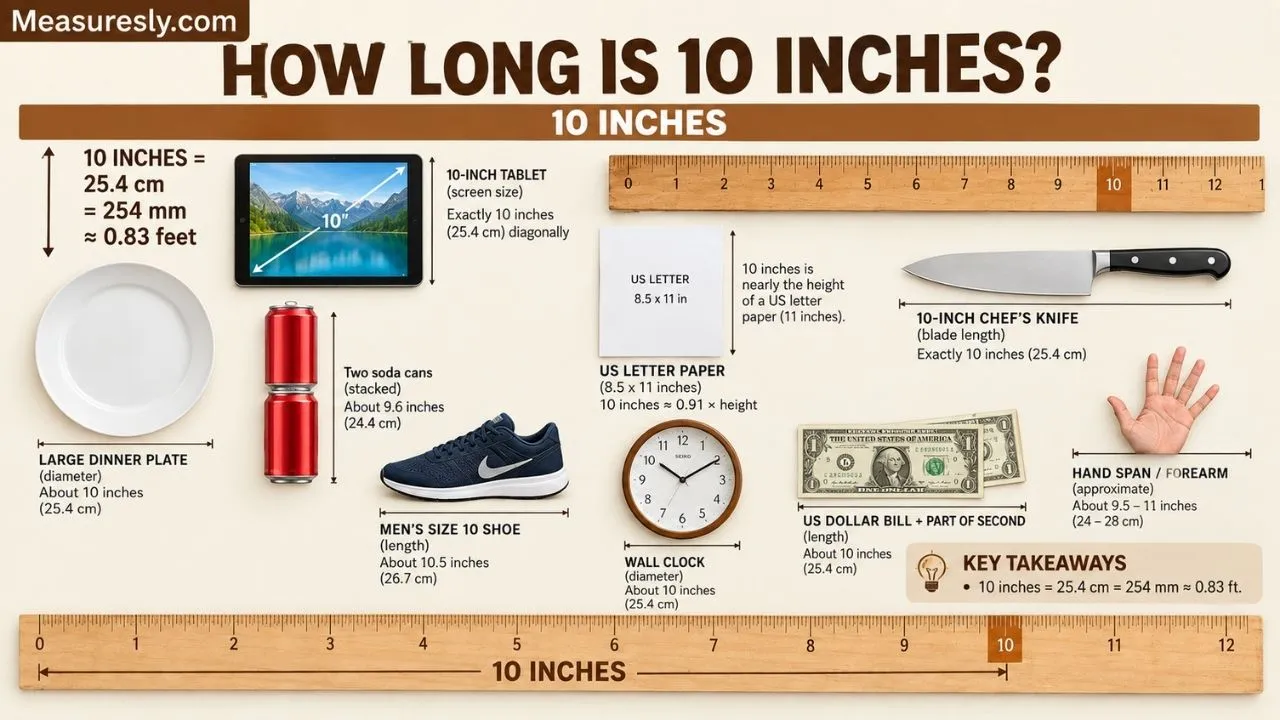

When someone asks “how long is 10 inches,” it’s rarely a math question – it’s a “can I picture this” question. Maybe you’re checking whether a package fits in a drawer, sizing up a gift box, measuring a shelf, or trying to settle a debate with a friend. Numbers on their own don’t mean much until you anchor them to something real, and that’s exactly what this guide is built to do. Below, you’ll find what 10 inches converts to in other units, a look at why the inch exists as a unit in the first place, a full breakdown of everyday objects that are roughly that size, a few practical situations where knowing this measurement actually matters, tricks for estimating length without any tools at all, and answers to the questions people ask most often about this exact measurement.
Understanding 10 Inches in Different Measurements
Before comparing 10 inches to real objects, it helps to see how it lines up with other common units of length. Here’s the full breakdown:
- Centimeters: 10 inches equals 25.4 cm – handy if you’re more used to the metric system.
- Millimeters: 10 inches works out to exactly 254 mm, useful for more precise measurements.
- Feet: 10 inches is 0.833 feet, or five-sixths of a foot.
- Yards: 10 inches comes out to about 0.278 yards, or just over a quarter of a yard.
- Meters: 10 inches converts to 0.254 meters, or roughly a quarter of a meter.
Going the other direction, if you’re wondering how long 10 cm is in inches, the answer is about 3.94 inches – nowhere near 10 inches, since an inch is more than double the length of a centimeter. That distinction matters when you’re reading product listings from overseas sellers, since mixing the two units up is an easy and surprisingly common mistake, especially when a listing simply says “10” with no unit attached.
Knowing these conversions can save you a real headache whether you’re following a recipe, checking furniture dimensions before a move, comparing shoe sizes across countries, or ordering something online from a site that lists everything in metric.
A Quick Word on Where the Inch Comes From
The inch has a surprisingly long history. Various early versions were tied to body parts – a thumb’s width, or the length of three barleycorns placed end to end, a definition used in England as far back as the 14th century. It wasn’t until 1959 that the United States, United Kingdom, and other English-speaking countries formally agreed on the modern definition: exactly 2.54 centimeters. That single agreement is what makes today’s inch-to-centimeter conversions clean and consistent no matter where you are in the world, and it’s why 10 inches will always equal 25.4 cm, with no rounding disagreements between countries.
Why Comparing to Everyday Objects Actually Works
Human brains are much better at remembering shapes and objects than they are at holding onto abstract numbers. This is a well-documented feature of memory and spatial reasoning: an image tied to a familiar object sticks, while a bare figure like “10 inches” or “25.4 cm” fades quickly if you don’t use it right away. That’s the whole idea behind object comparisons — once you’ve mentally paired 10 inches with, say, a dinner plate or a tablet screen, you’ll be able to eyeball similar lengths in the future without reaching for a tape measure at all. It’s the same reason recipes say “about the size of a golf ball” instead of giving a diameter in millimeters.
12 Common Things That Are 10 Inches Long
The easiest way to really grasp how big 10 inches is to compare it with familiar items you already have a feel for. Here are twelve everyday things that land right around that length, ranging from kitchen items to office supplies to things you’re probably wearing right now.
1. A Large Dinner Plate
Many dinner plates in a standard kitchen set run close to 10 inches across, a size chosen to comfortably hold a full meal without feeling oversized. If you picture the plate you’d use for dinner rather than the smaller one for salad or dessert, you’re picturing something very close to 10 inches in diameter. Some nutrition guides even recommend switching to a smaller 9- or 10-inch plate as an easy way to manage portion sizes without changing what’s actually on the menu.
2. A 10-Inch Tablet Screen
Tablets are typically named for their diagonal screen size, and “10-inch” models are one of the most common categories sold, sitting between compact phones and full laptops. Holding one of these in your hands gives you an almost exact physical sense of the length, since the screen size and the real-world measurement line up directly rather than needing any mental conversion.
3. A Standard School Ruler
A 12-inch ruler is the classic point of reference most people grew up with, and 10 inches sits just short of the full length — about 2 inches shy of the very tip. If you have a ruler nearby, this is the fastest and most literal way to see the length for yourself, since you can watch the 10-inch mark directly.
4. A Sheet of Letter Paper
US letter paper measures 8.5 by 11 inches, so 10 inches is almost the full height of a standard page, just an inch short of the top edge. It’s a size most people have sitting on a desk or in a printer tray right now, which makes it one of the most accessible comparisons on this list.
5. A Foot-Long Sub Sandwich
Sandwich shops commonly sell a 12-inch “footlong” sub, and 10 inches lands just a couple of inches short of that — closer to what many chains label a personal or 10-inch size. If you’ve ever ordered one, you already have a feel for roughly how far that stretches across a tray or wrapper.
6. A Large Chef’s Knife
Professional kitchens often use chef’s knives with a 10-inch blade, a size step up from the more common 8-inch home version favored by most household cooks. Laid flat, the blade alone – not counting the handle – stretches almost the entire length in question, making it a useful visual for anyone who spends time in the kitchen.
7. Two Stacked Soda Cans
A standard 12-ounce can is about 4.8 inches tall, so stacking two of them reaches roughly 9.6 inches – just shy of 10. It’s a quick reference you can build with items straight out of the fridge, no measuring tools required.
8. A Man’s Size 10 Shoe
A men’s size 10 shoe measures close to 10.5 inches from heel to toe, making it one of the most direct everyday comparisons available since footwear length is already something most people track. If you or someone nearby wears something close to that size, their own shoe is essentially a built-in ruler.
9. A Small Laptop Screen
Some compact laptops and larger e-readers have screens measured diagonally right around the 10-inch mark, similar to tablets in that department. It’s a useful comparison for anyone who spends more time around electronics than kitchenware, especially since screen sizes are printed right on the box.
10. A Wall Clock’s Diameter
Plenty of household wall clocks are sold in the 10-inch diameter range, a size large enough to read from across a room without dominating the wall it hangs on. If you have a clock like this at home, its face alone is a near-perfect match for the length being described.
11. A Standard Envelope, Laid End to End with a Pen
A standard #10 business envelope is about 9.5 inches long, and adding the cap of a typical pen brings the combined length right up to around 10 inches. It’s an improvised comparison, but a useful one if you’re sitting at a desk with nothing else within reach.
12. A Newborn Baby’s Head Circumference, Roughly
The average newborn’s head circumference is often cited as being in the 13 to 14.75 inch range, but a related measurement — the length of a small baby carrier handle or a standard baby shoe box – frequently lands close to 10 inches. It’s a less exact comparison than the others on this list, but one that resonates with new parents sizing up nursery furniture or storage bins.
If none of those are within reach, there’s a quick body-based trick too: most adult hands measure roughly 7 to 8 inches from wrist to fingertip, so 10 inches is about one hand span plus a couple of extra finger-widths. Your own stride, forearm, or even a credit card (which is a standardized 3.37 inches long) can all be combined to estimate 10 inches in a pinch.
Real-World Situations Where This Measurement Matters
Ten inches shows up far more often than you’d expect once you start paying attention to it. Here are a handful of everyday situations where knowing this length – and being able to picture it – genuinely comes in handy.
- Online shopping: Product listings often give dimensions without context, and knowing that 10 inches is close to a dinner plate or a tablet helps you judge fit before you buy, especially for items like storage bins, wall art, or electronics.
- Shipping and packaging: Many flat-rate shipping boxes and padded mailers are sized in inches, and a 10-inch dimension is common enough that recognizing it on sight can save you a trip to remeasure a box.
- Home improvement and DIY: Shelf depths, drawer interiors, and tile spacing are frequently specified in inches, and a quick mental comparison can tell you whether a project is feasible before you even pick up a tape measure.
- Gardening: Many seed packets recommend spacing plants 8 to 10 inches apart, and visualizing that gap helps with laying out a bed evenly without constantly stopping to measure.
- Crafting and sewing: Fabric cuts, ribbon lengths, and pattern pieces are often given in inches, so a fast reference point speeds up planning a project before you commit to cutting anything.
- Fitness and sports equipment: Items like resistance band lengths, yoga block heights, or the reach on certain equipment are sometimes described in inches, and a mental anchor helps when comparing products.
How to Estimate 10 Inches Without a Ruler
Not every situation gives you access to a tape measure, so it’s worth having a couple of backup methods in your pocket. Beyond the object comparisons above, here are a few more ways to estimate the length on the fly:
- Dollar bills: A US bill is 6.14 inches long, so laying one down and adding roughly two-thirds of a second one gets you close to 10 inches.
- Smartphones: Most modern smartphones are between 5.5 and 6.5 inches tall, so one phone plus about half of a second gives a rough 10-inch estimate.
- Your forearm: The distance from the inside of your elbow to your wrist is commonly close to 10 inches on an average adult, though this varies more than the other methods since everyone’s proportions differ.
- Two-finger widths repeated: An average adult finger is roughly 0.75 to 1 inch wide, so counting off about ten finger-widths in a row offers a rough, low-precision estimate.
None of these tricks are a substitute for an actual measuring tool when precision genuinely matters – for cutting wood, hanging shelves, or fitting a part, always reach for a tape measure. But for quick, casual estimates, these anchors get you close enough to make a confident call.
Quick Conversion Reference
| Inches | Centimeters | Millimeters |
| 1 in | 2.54 cm | 25.4 mm |
| 5 in | 12.7 cm | 127 mm |
| 10 in | 25.4 cm | 254 mm |
| 12 in (1 ft) | 30.48 cm | 304.8 mm |
| 20 in | 50.8 cm | 508 mm |
Why the Inch-to-CM Conversion Trips People Up
The US, Liberia, and Myanmar are the only countries that still rely on inches as the everyday standard — nearly everywhere else uses the metric system, so centimeters are the norm. That’s exactly why this question comes up so often: you’re comparing a US-sized measurement (a box, a screen, a tool) against a product listing, a recipe, or instructions written in metric. Keeping the 2.54 conversion factor in your back pocket, or bookmarking a page like this one, saves you from the classic mistake of ordering something that’s the right number but the wrong unit. It’s also worth noting that even countries on the metric system sometimes keep inches around for specific products — TV and monitor screens, tires, and pipe fittings are commonly sized in inches worldwide, purely out of longstanding industry convention.
Read More: How Long in 8 Inches? Real-Life Object Comparisons
10 Inches vs. Nearby Measurements
Sometimes the clearest way to understand a measurement is to see it sitting next to the sizes just above and below it. Here’s how 10 inches compares to some of its closest neighbors:
- 8 inches vs. 10 inches: The difference is 2 inches, or about the width of three fingers held together — noticeable side by side, but easy to misjudge from memory alone.
- 9 inches vs. 10 inches: Just 1 inch apart, this is a difference most people can’t reliably estimate by eye without a direct comparison.
- 10 inches vs. 12 inches (1 foot): A 2-inch gap again, but this one matters more often in practice, since 12 inches marks the familiar 1-foot benchmark most people already have memorized.
- 10 inches vs. 15 inches: A more substantial 5-inch difference, roughly comparable to the length of a smartphone laid next to the gap.
Frequently Asked Questions
No. 10 inches equals 25.4 cm, while 10 cm equals only 3.94 inches. An inch is more than two and a half times longer than a centimeter, so these two measurements aren’t close to each other, even though the number “10” is the same in both cases.
A 10-inch tablet screen (measured diagonally) or a standard dinner plate are two of the closest everyday matches, since both are typically sold and labeled right around that size rather than just happening to land near it.
Ten inches is 0.833 feet, or five-sixths of a foot — a bit shorter than the standard 12-inch ruler most people grew up using in school.
The most reliable no-tool methods are comparing against a known object, like a dinner plate, tablet, or two stacked soda cans, or combining smaller reference points like a dollar bill plus part of a second one. None of these are perfectly precise, but they’re accurate enough for casual, everyday estimates.
It largely comes down to historical momentum. The United States never fully converted to the metric system despite adopting it as a legal standard in 1975, and everyday tools, construction materials, and consumer habits stayed built around inches and feet. Switching an entire country’s infrastructure and manufacturing base to a new unit system is a massive undertaking, which is part of why the change never fully took hold.
Yes. Tablet and small laptop screens, wall clocks, pizza sizes at some restaurants, and certain kitchen knives are all commonly manufactured and marketed using 10 inches as a standard or near-standard size, which is part of why it’s such a useful length to have a mental picture of.
The Bottom Line
10 inches equals 25.4 centimeters — a length that’s just shy of a standard ruler, roughly the diameter of a dinner plate, or about the height of a 10-inch tablet held in your hand. It’s a measurement that shows up more often than most people realize, from shipping boxes to garden spacing to screen sizes, which makes having a solid mental anchor for it genuinely useful rather than just a trivia fact.
Next time you’re staring at a product spec and can’t quite picture the size, run the numbers through the 2.54 conversion factor, or just grab the nearest dinner plate, tablet, or ruler for a fast gut-check. With a few of these reference points memorized, you’ll be able to estimate lengths like this one accurately almost anywhere, no tape measure required.
Read More: How Long Is 9 Inches? A Simple Guide With Everyday Object Comparisons
Aarav Choudhary
I’m Aarav Choudhary, a content researcher and technical writer with a strong interest in online calculators, unit conversion tools, and educational resources. At Measuresly, I focus on simplifying complex calculations into practical, reader-friendly content. Every article I write is thoroughly researched, fact-checked, and regularly updated to ensure accuracy and reliability.