
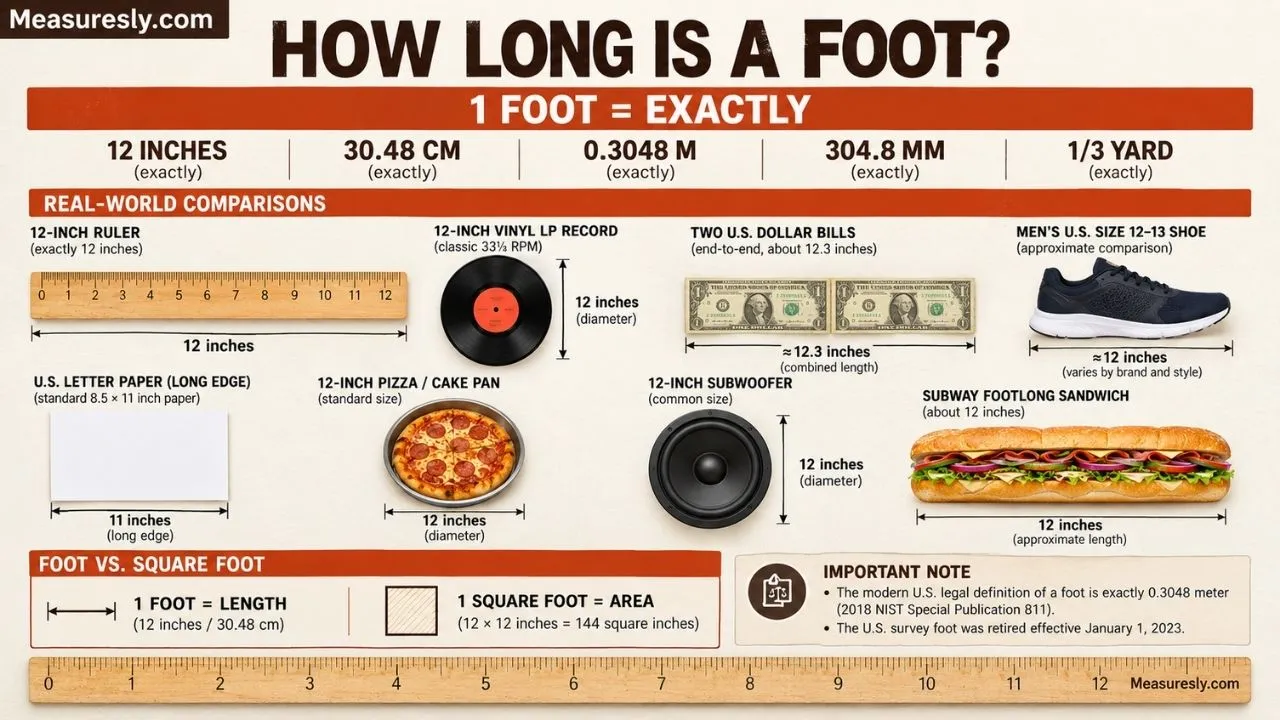

A foot is exactly 12 inches, or 0.3048 meters. That’s the full answer if you just needed the number — but “foot” gets used in a few different ways online, and mixing them up is where most of the confusion around this word comes from.
The Short Answer
One foot equals:
- 12 inches
- 1⁄3 of a yard
- 0.3048 meters
- 30.48 centimeters
- 304.8 millimeters
That’s true whether you’re measuring a room, a piece of lumber, or a person’s height in feet and inches. “Foot” also shows up in terms like linear foot and square foot, and in product names like Fruit by the Foot or a Subway footlong — and in those cases, it isn’t always a plain 12-inch length. More on that below.
How the Foot Is Officially Defined
The foot isn’t just a loose, historical stand-in for the length of a human foot anymore. In the United States, it has a precise legal definition tied to the meter: one foot equals exactly 0.3048 meter. That definition was set in 1959, when the United States, the United Kingdom, Canada, Australia, New Zealand, and South Africa agreed to align their versions of the foot so construction, manufacturing, and trade measurements would match across borders.
The International Foot vs. the Retired U.S. Survey Foot
Here’s a detail most pages skip. Before 1959, the U.S. had already defined the foot in 1893 as 1200⁄3937 of a meter — a fractional value that comes out to about 0.3048006 meters, a hair longer than the 1959 figure. Rather than replace that older definition everywhere at once, regulators kept it around for one narrow use: geodetic surveying. That older value became known as the “U.S. survey foot,” while the new 1959 value was called the “international foot.”
For decades, both definitions technically existed side by side, with surveyors and mapmakers using the older figure. The National Institute of Standards and Technology (NIST) and the National Geodetic Survey formally retired the U.S. survey foot at the end of 2022. As of January 1, 2023, the international foot — 0.3048 meter, exactly — is the only legally defined foot in the United States, for every application including surveying. The old survey foot is now used only for historic and legacy records.
The difference between the two versions is tiny — about two parts per million, or roughly a tenth of an inch over a mile — but it mattered enough for federal standards bodies to spend years phasing it out.
A Foot Compared to Other Units of Length
Once you know a foot is 12 inches, converting it into other common units is just arithmetic:
| Unit | Equivalent to 1 Foot |
| Inches | 12 in |
| Yards | 0.333 yd (1⁄3 yard) |
| Meters | 0.3048 m |
| Centimeters | 30.48 cm |
| Millimeters | 304.8 mm |
Three feet make up a yard, and a mile is 5,280 feet. If you’re converting the other way, one meter is a little longer than three feet (about 3.28 feet), which is why metric and imperial measurements never line up on a nice round number.
8 Everyday Things That Are About a Foot Long
Numbers are easier to picture with a real object next to them. A lot of “things that are 1 foot long” lists lean on items that just happen to be roughly that size without any real standard behind the number — an “average” shoe or a “small” pizza can vary by an inch or more depending on the brand. The items below are ones that are actually built, sold, or sized to a fixed standard at or near 12 inches, so the comparison holds up.
A standard ruler
This one is definitional rather than approximate — a 12-inch ruler is, by design, exactly one foot long, which is why it’s the most direct physical reference for the unit.
A 12-inch vinyl record
The standard LP record used throughout the music industry has a 12-inch diameter. It’s one of the few consumer products manufactured to that exact length on purpose.
Two U.S. dollar bills, end to end
Each Federal Reserve note measures 6.14 inches long, so two of them laid end to end come to about 12.3 inches — just over a foot, and a handy trick if you have cash but no ruler.
A men’s U.S. size 12–13 shoe
Standard shoe-size-to-length charts put a men’s size 12 at roughly 11.8 inches and a size 13 at roughly 12.2 inches heel-to-toe, which brackets a foot closely. Sizes above or below that range fall further away, so this only works as a comparison in that specific size range.
A sheet of U.S. letter paper, long edge
At 8.5 by 11 inches, the long edge is an inch short of a foot — useful precisely because it shows how close “close to a foot” can still be a real inch off.
A 12-inch pizza or cake pan
Bakeware and pizza pans are commonly sold specifically labeled by diameter, and 12 inches is one of the standard sizes carried by most kitchen retailers.
A 12-inch subwoofer
In both home and car audio, 12-inch is a standard driver size — it’s part of the product name because the cone itself is built to that diameter.
A Subway “Footlong” sandwich — when it’s made correctly
It’s meant to be 12 inches, though as the section below explains, that hasn’t always held up in practice.
Is a “Linear Foot” the Same as a Foot?
Yes — a linear foot is simply a foot measured in a straight line, with no width, height, or shape taken into account. The term shows up mostly in contexts like lumber, fencing, countertops, and fabric, where a supplier needs to specify that they’re charging by straight-line length regardless of how wide or thick the material is. If a board is priced at a certain rate “per linear foot,” that price covers 12 inches of length along the board — a 2-inch-wide board and a 12-inch-wide board of the same length cost the same per linear foot, even though one obviously contains more material.
So “linear foot” isn’t a different unit from “foot.” It’s the same 12-inch length, with “linear” added to make clear that width and depth aren’t part of the calculation.
Foot vs. Square Foot: Length vs. Area
A square foot is a different kind of measurement altogether: it’s a unit of area, not length. One square foot is the area of a square that measures 12 inches on every side — 12 inches by 12 inches, or 144 square inches.
This is where a lot of mix-ups happen. Saying a room is “10 feet” doesn’t tell you its area; saying it’s “100 square feet” does. A 10-by-10-foot room covers 100 square feet, while a 20-by-5-foot room also covers 100 square feet despite being a completely different shape. If you’re calculating flooring, paint, or tile, you need the square-foot figure (length times width), not the plain foot measurement of just one wall or edge.
When “Foot” Doesn’t Mean Exactly 12 Inches
The word “foot” also appears in a couple of well-known product names, and in both cases, the name doesn’t map cleanly onto the 12-inch definition.
How Long Is a Fruit by the Foot, Really?
Fruit by the Foot, the General Mills fruit snack, is longer than its name suggests. Consumer and food-media coverage that has measured the unrolled candy puts it at roughly three feet — commonly cited figures land around 34 to 36 inches once you unroll the strip and flatten out the folded tab at the end. General Mills has not published an exact official length, so treat any single precise figure (including this one) as an approximation rather than a spec.
Is a Subway Footlong Sandwich Actually a Foot Long?
Not always, and that gap became a well-known legal issue. In 2013, a customer in Australia posted a photo of a Subway “Footlong” sandwich that measured only 11 inches next to a tape measure, and the image spread widely. That triggered class-action lawsuits in the U.S. alleging that Subway’s footlong and six-inch sandwiches didn’t reliably measure up to their names.
Subway argued that natural variation in baking meant it couldn’t guarantee every loaf would come out at exactly 12 inches or more, and a federal judge ultimately found the company hadn’t done anything improper or unlawful — the bread dough was pre-weighed identically regardless of how long the baked loaf ended up. Even so, the parties settled in 2015: Subway agreed to give franchise locations a measuring tool and to build sandwich-length checks into its regular store inspections, so that footlong and six-inch subs would consistently meet their advertised lengths going forward. The settlement didn’t include payouts for most customers — ten named plaintiffs received $500 each, and the rest of the settlement covered attorneys’ fees.
How to Measure a Foot Without a Ruler
If you need roughly a foot and don’t have a tape measure handy, a few of the comparisons above double as quick estimates:
- Two U.S. dollar bills end to end (about 12.3 inches).
- A standard sheet of letter paper’s long edge, plus about an inch.
- Most smartphones now include a built-in measuring or AR ruler app that uses the camera to estimate length — useful for a quick check, though it’s less precise than a physical tape measure.
None of these substitutes are exact, so for anything that actually needs to be accurate — cutting material, filling out a form, or checking a product spec — use a real ruler or tape measure.
Frequently Asked Questions
Exactly 12 inches. That’s the definition, not an approximation.
30.48 centimeters, based on the international definition of 1 foot = 0.3048 meters.
In the United States, a foot is legally defined as exactly 0.3048 meters. NIST and the National Geodetic Survey confirmed this as the sole definition — retiring the older “U.S. survey foot” — effective January 1, 2023.
The modern definition has been stable since 1959. Before that, the U.S. used a slightly different value (about 0.3048006 meters) starting in 1893, and historically, different regions used their own “foot” lengths — commonly somewhere between about 25 and 34 centimeters — before international standardization.
There isn’t one, functionally — a linear foot is a foot measured as a straight-line length, used in contexts like lumber or fencing to make clear that width and thickness aren’t part of the measurement.
A foot measures length; a square foot measures area. One square foot is a 12-by-12-inch square, or 144 square inches — not the same thing as a 12-inch length.
A 12-inch ruler, a vinyl LP record, two U.S. dollar bills end to end, and a men’s U.S. size 12–13 shoe are all close to or exactly 12 inches, based on real product standards or sizing charts rather than rough guesses.
Roughly three feet once unrolled — commonly reported figures fall around 34 to 36 inches. General Mills hasn’t published an exact official length.
It’s supposed to be, and a 2015 class-action settlement required Subway to add measuring tools and inspections to make that consistent — but a court found the company hadn’t broken any law, since minor length variation came from baking, not from shortchanging customers on dough.
.
Read More: How Long Is 5 Inches? | How Big Is 2 Inches? | How Long Is 4 Inches?
Aarav Choudhary
I’m Aarav Choudhary, a content researcher and technical writer with a strong interest in online calculators, unit conversion tools, and educational resources. At Measuresly, I focus on simplifying complex calculations into practical, reader-friendly content. Every article I write is thoroughly researched, fact-checked, and regularly updated to ensure accuracy and reliability.